UV vs LED Nail Lamp: Which Is Better, and How Long to Cure Gel Polish?
Most nail lamps sold today are dual UV/LED. Find out how they differ from UV and LED lamps, what to check before you buy, how long to cure gel polish and why nails sometimes burn.
by Anastasia Kovalenko
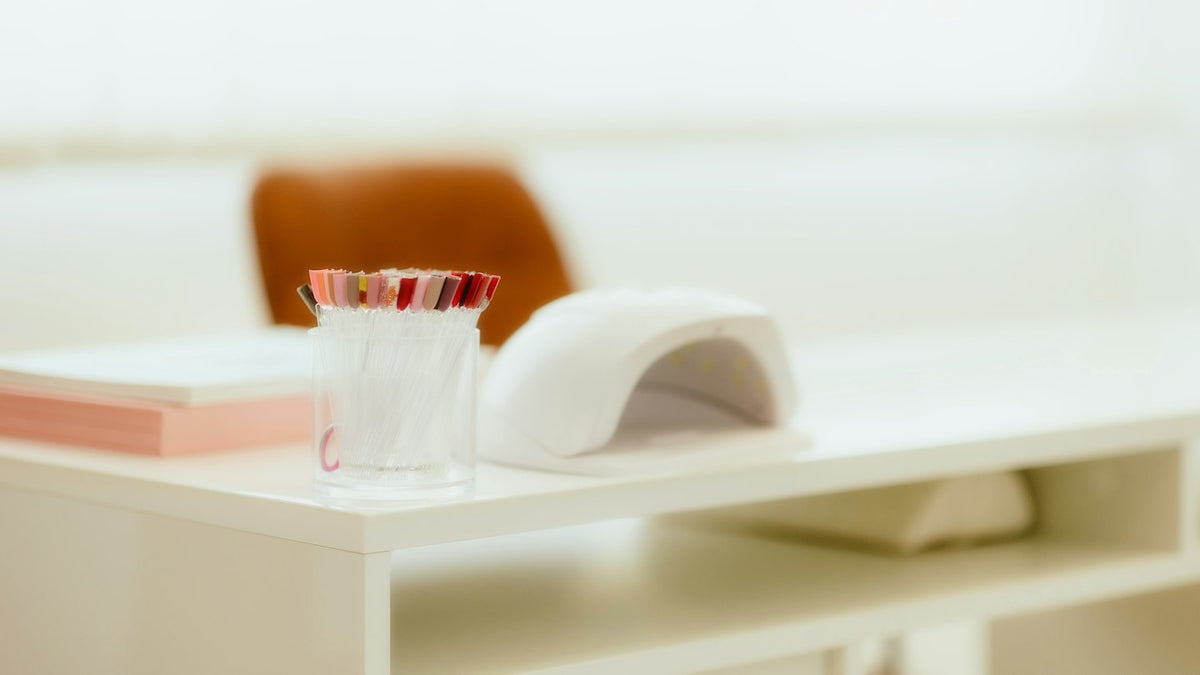
White UV/LED nail lamp on a white shelf in a manicure studio
UV vs LED Nail Lamp: Which Is Better, and How Long to Cure Gel Polish?
If you're weighing up UV vs LED nail lamps, the key difference is the light source. UV lamps use fluorescent tubes and cure gel slowly, while LED lamps use small diodes that cure it in a fraction of the time. Most lamps sold today are dual UV/LED models, which cure almost any gel.
This guide covers choosing and using a nail lamp and how long to cure gel polish. It also explains why nails sometimes burn under the light and whether a UV nail lamp is safe.
UV vs LED nail lamp: what's the difference?
Every gel, from base coat to top coat, contains photoinitiators: ingredients that react to light of specific wavelengths. When that light reaches them, they trigger polymerisation, the chain reaction that turns liquid gel into a solid layer. A nail lamp's job is to deliver that light evenly to every nail, at a high enough intensity.
UV nail lamps
A traditional UV nail lamp uses fluorescent tubes, like miniature strip lights, which give off a broad band of UVA light. Most gels react within that band, so a UV lamp cures a wide range of products, though slowly. The tubes weaken long before they stop lighting up, so replace them as often as the manufacturer recommends. Worn tubes are a common cause of under-cured gel.
LED nail lamps
An LED nail lamp uses light-emitting diodes, which produce intense light in a narrow band of wavelengths. That light is concentrated where modern gels react, so LED lamps cure much faster, and the diodes last for years. The catch with LED-only lamps is that some gels made for UV lamps don't respond to their narrow band and stay under-cured.
The name can be misleading, because LED nail lamps emit UV light too. Most shine in the UVA and violet range, so the same safety precautions apply to both types.
Dual UV/LED lamps
A dual UV/LED lamp, sometimes labelled "dual light source", combines LEDs of two wavelengths: one in the UV range and one at the violet end of visible light. Between them, they cure almost every gel, so you get LED speed without checking whether each new gel is LED-compatible.
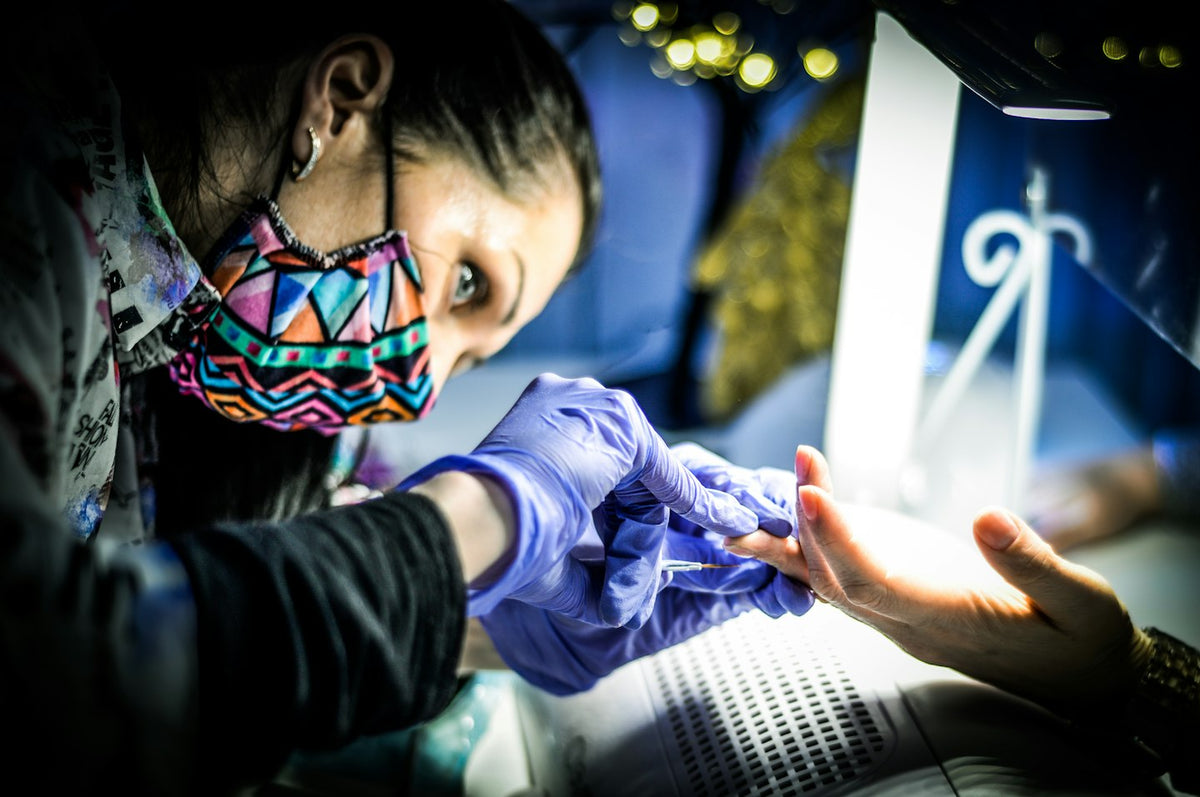
Each layer of gel is cured under the lamp.
UV vs LED nail lamp: which is better?
For home manicures and salon work alike, a dual UV/LED lamp is the better buy. It cures quickly, has no tubes to replace and works with virtually any gel, which matters as soon as you mix brands. An LED-only lamp is fine if all your gels are made for LED lamps, and a traditional UV lamp only makes sense if a gel's instructions call for one.
UV lamp
LED lamp
Dual UV/LED lamp
Light source
Fluorescent tubes
LEDs, one narrow band
LEDs, two wavelengths
Curing speed
Slow
Fast
Fast
Which gels it cures
Most gels
Gels labelled LED or UV/LED
Almost all gels
Maintenance
Tubes weaken and need replacing
LEDs last for years
LEDs last for years
How to choose a nail lamp
Dual lamps vary in quality, so check these points before you buy.
Even coverage. Wattage measures the electricity a lamp uses and says little about how much useful light reaches your nails. What counts is how many LEDs it has and where they sit: ideally across the top and down both sides, so the light reaches all five nails, thumb included.
Room for the whole hand. Your hand should lie flat inside with the fingers slightly apart. In a small or low lamp, the outer fingers sit near the edge and get less light, and long extensions can touch the top.
Several timer settings. Short and long presets make it easy to follow each product's curing time.
A low-heat mode. Some lamps start at a lower intensity and build up over the first few seconds, which reduces heat spikes with builder gel and thicker layers.
A removable base. If you do pedicures, a lamp whose base comes off can sit over the foot.
Safety marks. Check that the lamp carries the electrical safety marks required in your country.
During your first manicure with a new lamp, touch the cured no-wipe top coat on each nail. If the little finger or thumb feels tackier than the middle nails, the lamp has weak spots at the edges.
How long to cure gel polish
Always follow the curing time in your gel's instructions for your type of lamp. As a general guide, a thin coat of gel polish usually needs 30 to 60 seconds in an LED or dual lamp and around two minutes in a traditional UV lamp. Base, colour and top coat can each have their own time, and builder gel often needs longer. Our guide to gel nails compares the types of gel.
What you're curing matters too. Very dark shades, opaque whites and dense glitters let less light through, so the bottom of the layer receives less than the surface. Keep these coats extra thin, and use the longer time if your instructions give one. A thick coat can cure on top and stay soft underneath, which is why two thin coats cure better than one heavy one.
Signs of under-cured gel polish
A slightly tacky film on the base and colour coats after curing is normal. Called the inhibition layer, it forms because oxygen stops the very surface from hardening. It helps the next coat bond, so leave it in place unless your instructions say otherwise. Real under-curing shows up differently.
Wrinkles or ripples appear on the surface during curing, usually because the coat was too thick.
The gel dents or drags. A fingernail leaves a mark, or the colour smears when you brush on the next layer.
A no-wipe top coat stays tacky. Fully cured, it should feel smooth and dry, so give it another cycle and check your lamp.
The manicure lifts within days, because under-cured gel doesn't bond properly. Our guide to why gel polish lifts covers the other causes.
Can you over-cure gel polish?
An extra cycle won't spoil a manicure. If you doubt that a layer has fully cured, cure it again: uncured gel that reaches the skin is the main cause of gel allergy. Much longer or repeated cures bring no benefit, though, and can make gel brittle while adding heat and UV exposure.
How to use a UV/LED nail lamp, step by step
Even a good lamp can't fully cure a thick coat or a thumb held at an angle, so apply, clean and cure one layer at a time.
Prep the nails. Push back the cuticles and remove the dead skin from the nail plate, lightly buff away the shine, then cleanse and dehydrate with Prep Booster. Add an acid-free primer if your nails are oily.
Apply a thin base coat. Brush on a base such as RB01 Rubber Base Transparent, capping the free edge and leaving a hairline gap at the cuticle.
Clean the skin before curing. Remove any gel on the skin around the nail with a wooden stick: it causes lifting and can lead to an allergy.
Place your hand flat. Slide it all the way in, fingers slightly apart, so no nail sits in the shadow of the lamp's edge. When the hand lies flat, the thumbnails face sideways, so cure the thumbs separately with the nails facing up.
Cure for the full time, then repeat. Apply, clean and cure your colour the same way, normally in two thin coats. With cat eye gel, cure each nail within seconds of using the magnet, as our cat eye nails guide explains.
Finish with a no-wipe top coat.Diamond Top Coat seals the colour with a high-shine finish. Cap the free edge and cure.
That sudden burning feeling is a heat spike. The reaction that hardens gel gives off heat, and when a lot of gel cures at once, the heat builds up faster than it can escape. It's most common with builder gel, which goes on thicker than gel polish, and with powerful LED lamps, because a faster cure releases the same heat in fewer seconds.
Thin or over-filed nails feel it more, because less nail plate protects the nail bed. A heat spike fades within seconds; redness or itching that lasts after the manicure is a different matter, covered below. A few habits keep heat spikes to a minimum.
Apply thinner layers. With a builder gel such as B003 Milky White, build the structure in two thinner layers instead of one thick one, curing each in turn.
Use the low-heat mode if your lamp has one, so the intensity rises gradually.
Take your hand out if it burns. Wait a few seconds for the heat to pass, then put it back for a full cycle so the layer still cures completely.
Used as directed, a nail lamp exposes your hands to a small amount of UVA light for a few minutes per manicure. The risk from occasional use is generally considered low. Research into the long-term effects of regular exposure is ongoing, though, so it makes sense to limit it, whatever type of lamp you use.
Protect your hands. Apply a broad-spectrum sunscreen before you prep your nails, keeping it off the nail plates, since any cream left on them stops gel from bonding. UV-protective gloves with open fingertips are an alternative.
Stick to the recommended curing time and skip unnecessary extra cycles.
Don't stare into the lamp while it's on.
Ask your doctor first if you take medication that makes your skin sensitive to light or have a skin condition affected by UV.
The other risk is gel allergy. If the skin around your nails becomes red, itchy or swollen, or blisters appear, stop using the product and see a doctor or dermatologist. Keeping gel off the skin and curing every layer fully makes an allergy less likely.
Frequently asked questions
Do nail salons use UV or LED lamps?
Most salons now use LED or dual UV/LED lamps, because they cure faster and the LEDs rarely need replacing. Some professional gel systems are designed to be cured with a particular lamp, so salons often choose the one their gel brand recommends.
How do I tell if I have a UV or LED nail lamp?
Look at the light source: a UV lamp has tube-shaped bulbs, while an LED lamp has rows of small dots. The label or box usually says UV, LED or UV/LED, and a dual lamp often lists two wavelengths, such as 365 nm and 405 nm.
Can I use a regular LED lamp to cure gel nails?
No. Household LED bulbs, desk lamps and phone torches give off white light with almost none of the wavelengths gel needs. The gel won't harden properly, and uncured gel is an allergy risk. Always use a lamp made for curing gel.
Which is safer for your skin, a UV or LED nail lamp?
Neither is clearly safer, because both types emit UVA. LED and dual lamps cure faster, so your hands spend less time under the light, but that light is more intense. Whichever lamp you use, a broad-spectrum sunscreen or fingerless gloves reduce your exposure.
Once your lamp is set up, choose your shades from our gel polish and builder gel collections, and finish with one of our top coats.
Itching or redness around your nails hours or days after a gel manicure can be a sign of allergy. This guide explains why it develops, what to do if your skin reacts and how to prevent it.
A colour that seems to rise from the nail and a line as clean as a retouched photo: the Russian manicure explained step by step, with the rules for doing it safely.
A veil of soft, translucent white that makes every hand look cared for. How to choose your milky shade, get a streak-free finish and wear it in a modern way.