


Nails for Men: The Men's Manicure, Step by Step
Short, even nails and neat cuticles in fifteen minutes every two weeks. The men's manicure step by step, with nothing painted on the nails.
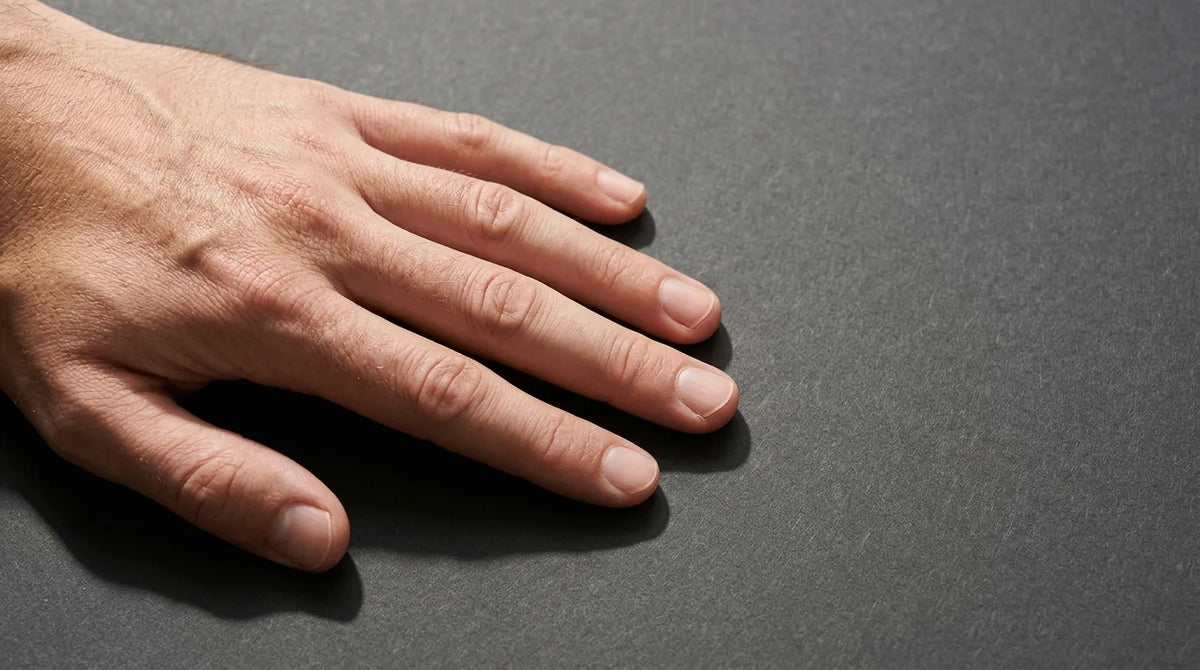

Nails for men need nothing painted on them, only a short routine of about fifteen minutes every two weeks: clip, file, tidy the cuticles, buff lightly and finish with a nail dehydrator. The result is a pair of hands with short, even nails and neat edges.
This guide covers the tools you need, the men's manicure step by step, the right length and shape, the problems that come up most often and what to ask for in a salon. The last section explains how nail technicians can offer the same service to male clients.
A men's manicure is a preparation of the natural nail and nothing more. The nails are shortened and shaped, the cuticles are pushed back, the surface is evened out and the nail plate is cleaned. The hands look cared for, and nothing shows on the nails.
At home it takes ten to fifteen minutes. In a salon it is a short appointment that many men book as regularly as a haircut, or before a job interview or a wedding.

The whole kit fits in a bathroom drawer, and apart from the dehydrator, every item is a general tool sold in most pharmacies and beauty shops.
Small cuticle nippers are useful for a loose hangnail, but only for that. A cuticle oil or a hand cream is an optional extra for the skin around the nails.
Work in good light and finish one hand before you start the other.
Several small cuts are better than one large cut, which puts pressure on the whole tip and can split the layers of the nail. Leave about a millimetre more than the length you want, then finish with the file, which gives you more control and a smoother edge.
Move the file from the side towards the centre, lift it, and start again from the side. A back-and-forth sawing movement heats and frays the edge, and a frayed nail catches on clothing and peels. File your nails when they are dry, because a wet nail is softer and tears more easily.

The cuticle is the thin layer of skin that grows onto the base of the nail. After a few minutes in warm water, or after a shower, it is soft enough to push back towards the finger with light pressure. Hold the stick almost flat against the nail and work in small strokes from the centre to the sides.
Never cut the living skin around the nail. It protects the nail from infection, and when it is cut it often grows back thicker and more ragged. Trim only a hangnail, a small strip of loose dry skin at the side, with clean nippers close to its base and without pulling. Our guide to cuticle oil and cuticle care explains how to keep this skin soft between manicures.

Buffing smooths the surface so light ridges show less, but every stroke also removes a little of the nail. Two or three passes per nail are enough, once every two weeks at most. Aim for an even surface with a soft natural sheen; a mirror shine means the nail has been buffed too much and thinned.

Filing and buffing leave fine dust, and your skin leaves natural oil on the nail. Brush the dust away first, then the dehydrator leaves the nail plate clean at the end of the preparation.
Prep Booster dries in seconds. It takes oil and moisture off the nail plate without leaving it dry, white or brittle, and it has a mild smell. Apply a thin layer over the whole nail, keep it off the skin, and let it dry. If you use a cuticle oil or a hand cream, put it on afterwards and work it into the skin around the nails only.

For most men, a full manicure every two weeks keeps the nails at the right length. A fingernail grows about 3 millimetres a month, so after two weeks the tip is just long enough to start catching dirt and breaking.
Between manicures, men's nail care takes a minute or two. Smooth any rough edge with the file as soon as you notice it, brush under the nails when you wash your hands, and use the towel to push the cuticles back after a shower.
The most practical length leaves a thin white line of free edge that you can just see past the fingertip when you look at the palm side of your hand. At this length the nails stay out of the way for typing, sport and manual work, and dirt has little room underneath.
For the shape, follow the line of your fingertip. A straight edge with softened corners, often called squoval, suits wide nails and broad fingers. A gently rounded edge suits narrow nails and is the easiest to keep smooth. Do not file deep into the sides, because the corners can then grow back into the skin. Toenails are always filed straight across, with the corners only softened, never rounded.
Most problems come from dry skin, manual work or habits such as biting. The routine above helps with many of them, and some need a doctor.
See a doctor if the skin around a nail is broken, red, swollen, painful or infected, or if a nail lifts, thickens or changes in shape or appearance, or if ridges or spots appear suddenly or spread. A dark line or band under a nail that is new or changing must be shown to a dermatologist promptly.
Ask for a men's manicure, or a manicure without polish, and say how short you want your nails. A good technician will ask about the shape you prefer and the work you do, then file the nails, tidy the cuticles, buff lightly and clean the nail plate with a dehydrator.
If you want your cuticles pushed back only, with no cutting, say so at the start, and mention any sore or broken skin before the technician begins.
A preparation-only manicure takes ten to fifteen minutes and suits clients who come back every two weeks or so. Give it a clear name on your menu and list what it includes: shortening and shaping, cuticle work, light buffing and the dehydrator at the end.
A technician can do the cuticle work with an e-file, using a fine bit at low speed. It is the same technique as in the Russian manicure, and it takes training and practice before you use it on clients. Our Professional Cordless Nail Drill runs from 0 to 45,000 RPM, so the speed can stay low for this work. It is quiet, with low vibration, and the handpiece stays cool. It takes standard 2.35 mm bits and is sold without them; our nail drill buying guide explains what to look for in a drill.
Once the dust is brushed away, finish every client with Prep Booster. Because it dries in seconds, the client leaves straight away with bare, clean nails. Keep the service to the steps on your menu, so clients know what to expect next time.
Yes. A manicure is part of regular grooming, like a haircut, and many salons and barbers offer a men's manicure. You can also do one at home in about fifteen minutes.
Clip the nails short in several small cuts, leaving a little length, then file the tips straight across and soften the corners. Move the file in one direction only, and file your nails when they are dry.
Yes, gently, once they are soft from warm water or a shower. Push them back with a wooden stick or a rounded pusher and never cut the living skin; only a loose hangnail is trimmed.
Keep them short, brush under them when you wash your hands, and file away any rough edge where dirt can collect. At the end of a manicure, a nail dehydrator such as Prep Booster takes oil and moisture off the nail plate, so the nail is left clean.
No, the nails stay bare. The dehydrator is the only product used on the nail, and any cuticle oil or hand cream goes on the skin around it.
If you want to add e-file cuticle work to your services, the cordless drill is in our nail drills collection.
Carnival Nails: 14 Bright Ideas with Glitter, Colour and Shine
12 min read
Neon Nails: 12 Bright Ideas and How to Make Neon Colours Pop
11 min read
Nails by Month: The Nail Colours and Designs to Wear from January t…
12 min read
Encapsulated Nails: How to Seal Glitter, Dried Flowers and Foil in …
12 min read
Free delivery from Lek 7,000
Shipped from Nice, France
Prepared in 1 to 2 business days
For orders placed before 2 pm, Paris time
14-day returns
From the day you receive your order
Secure payment
Encrypted checkout
Nail tech, salon or distributor? Join the Elegelli professional programme for pro pricing.


