French Tip Nails: 20 Modern French Manicure Ideas and How to Do Them
Micro French, baby boomer, navy, bordeaux or gold: 20 ways to wear French tip nails, plus the smile line that suits each shape and three ways to draw a clean line in gel.


French tip nails pair a natural-coloured base with a band of white or colour along the free edge. This is the familiar French manicure, and it works at any length because it follows the nail you already have. A modern French manicure changes four details: the line is thinner, the base is sheer or milky, the shape is a rounded almond or squoval, and the tip can be any colour from forest green to gold.
This guide covers the smile line that suits each nail shape, 20 French tip nail ideas with their gel method, and how to do a French manicure at home, step by step.
The smile line is the curve where the tip meets the base, and it decides whether French nails flatter the hand. Two rules are a good starting point for any shape: the curve should echo your cuticle line, and the shorter the nail, the thinner the tip.
Our guide to nail shapes will help if you haven't settled on one yet.
Every idea below starts on prepped nails with a cured sheer base and ends with a no-wipe top coat, capped over the free edge. Each layer goes on thin and is cured under a UV/LED lamp for the time in your gel's instructions. A few tips are built in builder gel, which gives a fuller band and is filed off at removal, never soaked.
A sheer nude-pink base, a fine white tip and a tapered almond make up the French most people picture today, and it goes from the office to a wedding unchanged. Over RB03 Cachemire, a muted dusty pink rubber base, draw a tip about two millimetres wide in 002 White, a bright white gel polish. On longer almonds, a small bead of B027 Blanc Meije, a frosted white builder gel, builds the tip and strengthens it.

On short nails with rounded corners, a white tip gives a neat finish that stays practical if you type all day or work with your hands. Keep it to about a millimetre, with the smile line nearly straight, because a wide white band makes a short nail seem shorter. A silicone stamper, explained in the step-by-step section, gives a very even line at this length.

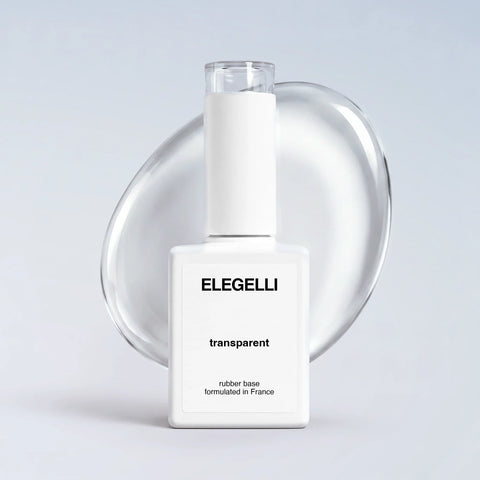
A micro French is a line no wider than a thread, drawn along the very edge of the nail. It works on the shortest lengths, grows out almost unnoticed and needs only a sheer pink or clear base, such as RB01 Transparent. To draw it, load a long striper brush with very little white gel, rest its side against the free edge and turn your finger slowly beneath it.

The milky French tones down the contrast between tip and base, for anyone who finds bright white too stark. Cure a white tip as usual, then float one thin coat of 021 Cloud, a sheer milky white gel polish, over the whole nail, tip included. Nails that bend easily do better the other way round: build the milky base in a thin overlay of B003 Milky White builder gel, which adds strength, then draw the white tip over it. Keep either layer thin, as milky shades whiten where the gel is thicker.

Baby boomer nails are a French with no line: pink at the cuticle fades into milky white at the tip. The gradient hides regrowth well, though it needs a medium or long nail. Over the cured pink base, apply Milky White to the outer half of the nail, then pull its border towards the cuticle with light strokes of a clean, flat brush. A seamless fade takes practice, and our guide to ombre nails with gel polish explains the blending.

Pink and white nails are a French manicure built in gel: the nail is made of two builder gels, a soft pink over the nail bed and a white free edge, meeting in a clean, curved smile line. Because the white is part of the structure, the tip does not chip off the way a painted line can.
A painted French is redrawn with every set, while pink and white is built like any builder gel overlay: fuller, stronger, and filed off, never soaked. As the nail grows, the white moves forward, so at each builder gel infill the regrowth is filled in pink and the white rebuilt where the free edge now begins.
After the prep of the step-by-step section below, build it as an overlay on natural nails, or on a form for length, as in our guide to gel nail extensions on forms.
With no line, the pink blends into the white in a pink and white fade. That is the baby boomer of idea 5, and our baby boomer nails guide explains it in detail.

Any shade can replace white, as long as it stands out against the base. Deep colours give the sharpest line, while pastels need two thin passes. Match the base to your skin: pink for fair and cool tones, peach for warm, olive or tanned ones.
Deep green is a good first colour French if you normally wear nude: from a distance it reads as a dark outline, and the green only shows up close. It sits well next to cream knitwear, camel coats and gold jewellery. A forest green such as 046 Fir Tree should cover in a single stroke, which keeps the line thin.

Lilac goes with cool undertones and silver jewellery, and it is freshest in spring, with a white shirt or a floral dress. Like most pastels, 022 Lilac covers best in two thin passes, each one cured, because a single thick stroke leaves a ridge along the tip. Make the first pass almost transparent and let the second even out the colour.

A wine-red tip gives the depth of burgundy in a small dose, which helps if a full set feels too dark. Our deep bordeaux, B014 Amarante, is a builder gel, so the tip comes out a little fuller and is best on medium and long nails. Shape a small bead with a flat brush and cure each nail straight away, before the gel levels and widens. More ideas are in our burgundy nails guide.

Navy gives the same graphic edge as a black French and is kinder to fair skin. It goes as easily with denim as with a suit at the office. Over a sheer nude base, draw a fine tip in a deep blue such as 113 Sapphire and cap the free edge. Any slip of dark blue shows on the skin, so lift it with a clean brush before curing.

Pink French tips are the gentlest step into colour: a pink tip over a pink base stays in one colour family. For a brighter version, draw the tip in 020 Raspberry, a bold raspberry pink, over Cachemire; it works on short nails too. File all ten nails to the same length first, because a vivid tip draws the eye straight to the free edge.

Brown is the warm counterpart to navy, at home in autumn next to wool and suede, and particularly flattering on olive, tanned and deep skin. Pair 009 Cocoa, a deep brown, with a peach-toned base such as RB04 Pêche, so that tip and base share the same warmth. On almond nails the tip can be a little wider, since the curve stops the dark colour seeming heavy.
A pale blue tip is at its best on holiday, with white linen and sandals. Draw it in 109 Sky, an airy blue, in two thin passes, since pale shades streak in a single coat. For a pastel set, alternate Sky and Lilac from nail to nail and keep every tip the same width, so the mix seems deliberate.

These five designs move the line or multiply it. Most ask for a steadier hand, so get comfortable with the plain French first.
The double French adds a second, thinner line about a millimetre below the tip, following the same curve, with bare base between the two. It needs room, so it belongs on medium and long nails. Draw and cure the tip first, so that a slip on the second line can be wiped away without touching it. Two white lines are the quietest version; white with gold is dressier and suits an evening out.

In a V French, two straight lines run from the sides of the nail and meet in a point at its centre, and the tip above them is filled in. Straight strokes are easier to control than a curve, and the V lengthens almond and coffin nails. Pull each line towards the centre with a liner brush, or guide it with striping tape pressed onto a wiped, cured base and peeled off before curing.

The reverse French moves the line to the other end of the nail: a thin crescent follows the cuticle, and the tip stays bare. Short nails wear it well, as nothing at the free edge shortens them. This is the hardest place to keep gel off the skin, so leave a hairline gap at the cuticle. Regrowth also shows sooner than with a tip, usually within a couple of weeks.

A side French sweeps the tip across the nail at a slant, from low on one side to the opposite corner of the free edge. The diagonal slims a wide nail bed and is forgiving for beginners, as the two sides of the nail don't have to match. Start the stroke on the same side for every nail of one hand and mirror it on the other.

An outline French traces the tip without filling it: one fine line draws the smile line, a second follows the free edge, and the sheer base shows between them. Save it for medium or long almond and coffin nails, where the gap has room to show. Use a long striper brush and a deep shade such as Fir Tree or Sapphire, and cure the smile line before adding the edge line.
Metallic tips turn French nails into party nails. Choose between gold and silver as you would for a watch or a necklace: gold flatters warm undertones, silver cool ones.
A gold tip over a nude base works like jewellery for a wedding, a party or the festive season. Press a small bead of B030 Or Solaire, a builder gel with a golden reflection, along the free edge with a flat brush, and cure it straight away. This gives a slim band for medium and long nails; on short ones, gold gel paint on a striper brush draws a finer line.

Silver has a colder, sharper shine that goes with winter evenings, grey or black outfits and white gold rings. It is most striking over a milky base, so cure one coat of Cloud over the sheer base first. Then lay a small bead of B033 Argent Sterling, a pure metallic silver builder gel, along the free edge with a flat brush, as for gold. Metallic pigment shows brush marks, so place the gel in as few strokes as you can.
A glitter fade replaces the line with sparkle, densest at the free edge and thinning towards the middle. With no smile line to draw, it is the most forgiving of the twenty. Apply B025 Poussière de Diamant, a transparent builder gel with a subtle shimmer, to the last third of the nail, then drag it towards the centre with a brush that holds almost no gel. For a stronger sparkle, pat fine glitter onto the uncured edge with a dry brush, cure, and seal it under top coat.
A clean French depends on two things: an even base and a steady, fine line.
You don't need a boxed French tip nail kit. Most of the designs above use the same few items: a nail dehydrator, a sheer base, a white or coloured gel, a no-wipe top coat, a fine liner brush, gel cleanser and a UV/LED lamp. The dehydrator, bases, colours and top coat named in this guide are ours; the lamp and the brushes are standard tools that we don't sell, and any gel cleanser will do.
A French pedicure follows the same steps with a thinner line. File the toenails straight across, apply a sheer pink base and draw a white tip about a millimetre wide on the big toe; on the smaller toes, a sliver of white is enough. Our gel pedicure guide covers prep and more toe nail designs.

A modern French manicure keeps the natural base and contrasting tip of the original and refines the details. The line is thinner, the base is sheer or milky, and the tip can be white, coloured, metallic or blended into a gradient.
Yes. Keep the tip very thin, as in a micro French, and the smile line shallow, so the pink part of the nail stays as long as possible.
A French manicure has a visible line between base and tip, while baby boomer nails blend the same pink and white into a gradient with no line. The baby boomer needs more length and more practice, and it hides regrowth better.
Use a long, fine liner brush with very little gel, and turn the finger while the brush stays still. Draw from each side towards the centre, then correct the curve with a brush dipped in cleanser before curing.
Any colour works, as long as it stands out against a sheer base. Deep green, bordeaux, navy and chocolate brown are at their best in autumn and winter, while lilac, sky blue and raspberry pink belong to spring and summer. Gold and silver are for parties.
Pink and white nails are a French manicure built in builder gel rather than painted. A pink gel covers the nail bed, a white gel forms the free edge, and the two meet in a curved smile line.
They look alike, but a classic French draws a tip over a sheer base, while pink and white nails build the whole nail in two builder gels. Because the white is built into the nail, it grows out with it and is rebuilt at each infill instead of being redrawn.
The shades and bases named in these ideas come from our gel polish, builder gel and rubber base collections.
French Tip Toes: How to Do a French Pedicure with Gel, Plus 10 Ideas
11 min read

Best Base Coat for Gel Nails 2027: Our Pick and a 5-Brand Comparison
13 min read

Builder Gel Kit for Beginners: What You Need for Builder Gel Nails …
11 min read
Best Cat Eye Gel Polish: How to Choose the Gel, the Magnet and the …
10 min read
Free delivery from Dhs. 320
Shipped from Nice, France
Prepared in 1 to 2 business days
For orders placed before 2 pm, Paris time
14-day returns
From the day you receive your order
Secure payment
Encrypted checkout
Nail tech, salon or distributor? Join the Elegelli professional programme for pro pricing.