Quilted Nails: How to Do the Puffy Diamond Grid with Gel
The puffy diamond grid of quilted nails, built in thin gel layers: the exact order of steps, the gel for each layer and how to fix what goes wrong.
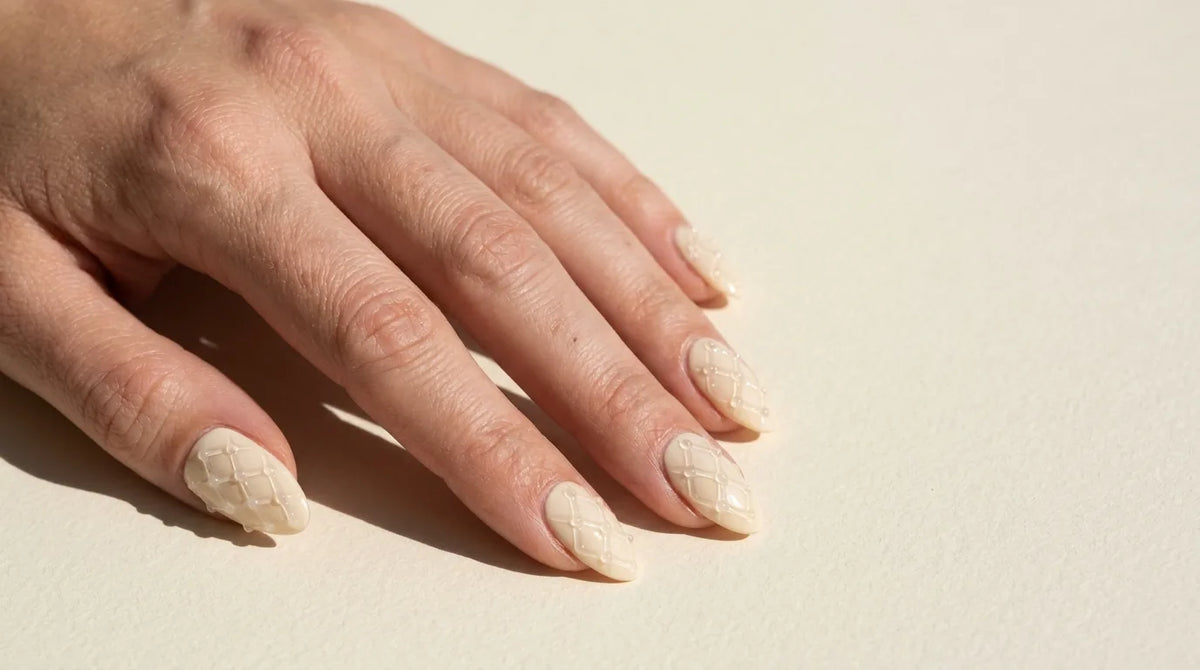

Quilted nails are nail art modelled on quilted fabric: a raised, puffy diamond grid, often with a tiny round part at each point where the lines cross. In Japan the design is called kirutingu nail (from the word for quilting), and Japanese pages place it in autumn and winter, the season of the warm padded fabric it copies.
The whole skill is in thin layers, each cured before the next: a flat colour, a fine grid, then cushions filled one diamond in two. This guide gives the layer order, the gel for each layer and the fix for what goes wrong.
The set on the cover is done in 075 Beige, a soft natural beige, with clear cushions in B025 Poussière de Diamant, a transparent builder gel with a subtle shimmer, under Diamond Top Coat.
Japanese tutorials fill the cushions with a clear gel, and one Japanese nail site names a thick art gel such as icing gel, firm enough to pull a string from the brush. The puffy look it gives is called pukkuri in Japanese. Elegelli does not sell these art gels.
A softer, self-levelling clear gel works too, as long as you place it little by little. Our clear option is B025 Poussière de Diamant, a transparent builder gel with a subtle shimmer, and B011 Crème d'Ivoire gives an ivory cushion with colour and height in one step. Using builder gel is our own method, not the Japanese standard. Both cure in 60 seconds under LED or 120 seconds under UV.
Whichever gel you choose, try it on a practice tip before a full set. A self-levelling gel spreads, so take a small amount for each diamond and build the height in two thin layers, curing each one.
You also need bullion, the tiny round parts of about 0.5 mm that mark the crossings, and a fine liner brush for the lines. Elegelli sells neither.
Prepare the nails as you would for any gel manicure; our guide to applying gel polish at home covers the prep in detail. Then work in the order below and cure every stage before you start the next, following the curing time in the instructions of each gel.
Wipe the liner brush often so the stitch lines stay thin.

After step 6 you should see raised cushions in a checkerboard pattern with flat diamonds between them. Check their height from the side, then fill the rest to match.

The height should always come from thin layers, never from one thick load cured for longer. A thick layer can stay undercured inside, and it can heat up: in one test by Japan's National Consumer Affairs Center, a thickly applied UV gel on a nail tip reached 60 to 65°C underneath while it cured under the LED lamp supplied with it. When a cushion needs more height, add a second thin layer and cure that.
Uncured gel matters for the skin too: a Japanese medical journal states that unpolymerised acrylic monomers are what sensitise it, so thin, fully cured layers and gel kept off the skin reduce one cause of allergy. They cannot rule allergy out. If the skin around the nail turns red, itches or swells, stop using the product and see a doctor; our guide to gel nail allergy explains the signs.
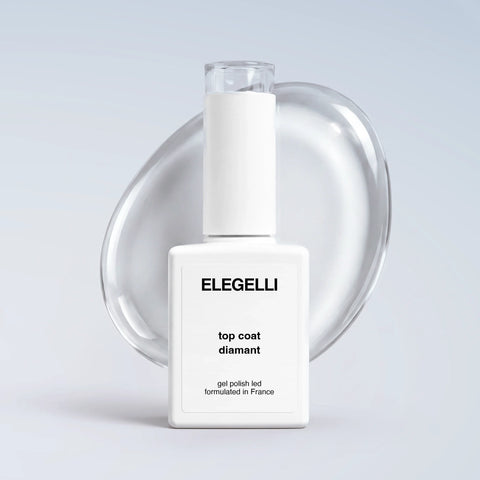
Japanese tutorials lay a thin matte coat under the grid before the lines. This guide keeps every top coat for the last step instead, so nothing is painted over a cured top coat. Diamond Top Coat gives the raised parts a mirror shine and does not yellow over whites and nudes.
For a softer, velvet finish, use Matte Top Coat in place of the glossy top coat at step 8. The quilting then shows through its relief alone, a quieter finish on beige and brown. Our guide to matte nails has more ideas for this finish.

One Japanese nail site recommends soft ivory and beige palettes. 075 Beige is a natural beige, and 074 Vanilla is a creamy beige; ivory cushions in B011 Crème d'Ivoire can go over either. 002 White is a bright white; for an even white under the grid, apply it in thin coats, curing each, and use clear cushions over it.
083 Sugared Almonds, a powdery pink, works well with clear or gold stitching. For a darker winter set, try 010 Coffee, a deep rich brown; clear cushions over it keep the brown visible.
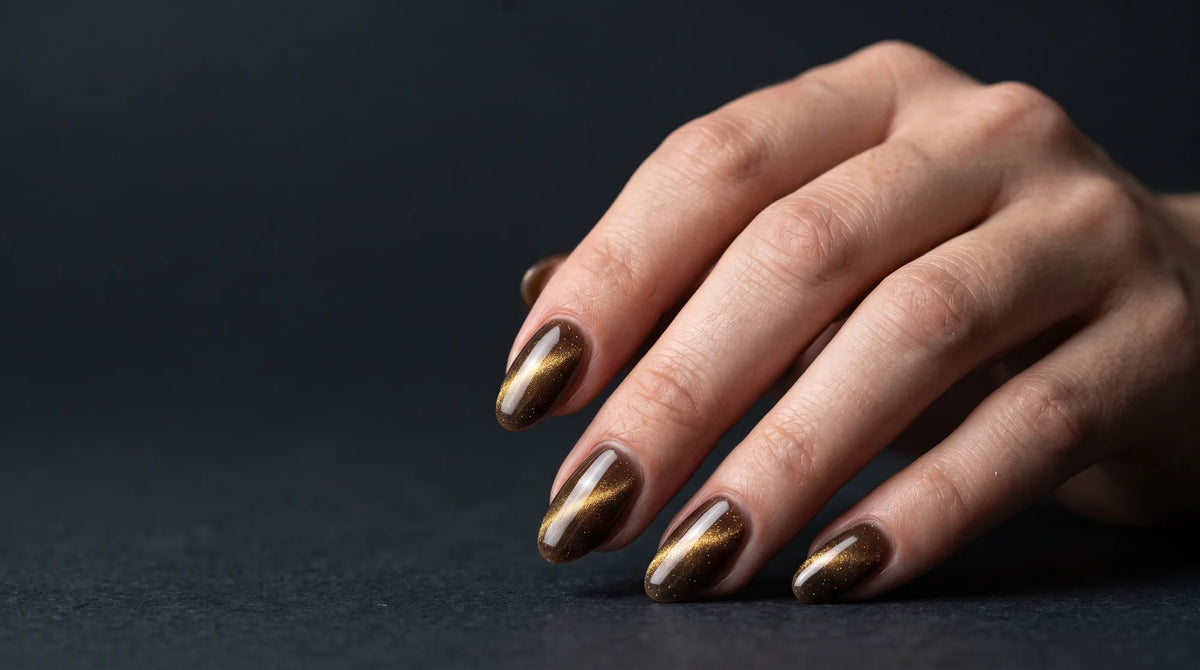
In Japan, cat eye gel is called magnet gel, and one Japanese nail site suggests a beige or brown magnet base under clear cushions. The cat eye shades 002 Bronze Flame (a warm bronze beam) and 005 Dark Aurora (a deep chocolate shimmer) suit it, and 001 Golden Veil (a golden glow) works too. Make the cushions in a clear gel such as Poussière de Diamant, since an ivory gel would cover the beam. Our cat eye nails guide explains how to place the magnet.

To stitch in gold, draw the lines of step 5 with a metallic gold liner gel instead of clear gel. Elegelli does not sell one. Take very little on the liner brush, keep the gold lines thin and cure after every two or three lines, then carry on with steps 6 to 8.

A single quilted nail, for example on the ring finger, with the others in the same plain colour is the quickest version and a good first attempt.
One Japanese beauty site gives an easier method that skips the drawn grid: clay gel is spread over the whole nail and the quilting lines are pressed in with a silicone tool or a wood stick, before the cure and the top coat. Elegelli sells neither clay gel nor these tools, and our builder gels self-level, so they would not hold a pressed line. For other raised designs in builder gel, see our guide to 3D nail art with builder gel.
On short nails, keep the diamonds the same size rather than making the grid finer. A smaller grid leaves each cushion too little room to rise, so the short nail simply carries fewer diamonds. Keep the cushions low, and quilt one accent nail rather than all ten.

Start by filing the cushions and the bullion down until the surface is flat; builder gel cushions are always filed, never soaked. Then remove the rest as usual, since a soak-off gel polish can be soaked off or filed. Our guide to removing gel nails with an e-file shows how to take the layers down while sparing the natural nail.
Quilted nails need a base, a colour, a clear gel for the cushions and a top coat.
Other top coats are in our top coat collection.
Quilted nails copy quilted fabric: a puffy diamond grid, often with a tiny round part at each crossing, a design Japanese pages place in autumn and winter.
Japanese tutorials use a clear gel, and one Japanese site names a thick art gel such as icing gel, firm enough to pull a string. A self-levelling clear builder gel such as B025 Poussière de Diamant also works if you place it little by little and test it on a tip first.
Yes. Set the beam with a nail magnet on one thin coat of cat eye gel, cure straight away, lightly buff the shine, then build the grid and the cushions on top in clear gel, which keeps the beam visible.
An easier version is clay gel spread over the nail, with the lines pressed in by a silicone tool. If you use the step-by-step method, start with one accent nail and fill one diamond in two.
Yes. Keep the diamonds the same size as on long nails, so the nail carries fewer of them, keep the cushions low, and quilt one accent nail only.
Set each bullion in a small dot of gel and cure it before you draw the lines, then make sure the final top coat covers them completely.
The clear and ivory gels for the cushions are in our builder gel collection, and the bronze and brown bases in our cat eye range.

Melhor base para verniz gel: base clássica ou rubber base, por tipo…
12 min de leitura

Kit de builder gel para iniciantes: o que precisa para fazer as unh…
12 min de leitura
Verniz olho de gato: como escolher o melhor gel cat eye, o íman e o…
11 min de leitura
Verniz gel ou Shellac: a diferença, quanto dura cada um e como tirar
12 min de leitura
Envio gratuito a partir de $86
Enviado de Nice, França
Preparado em 1 a 2 dias úteis
Para encomendas feitas antes das 14h (hora de Paris)
Devoluções em 14 dias
A partir da receção da encomenda
Pagamento seguro
Pagamento encriptado
Técnica de unhas, salão ou distribuidor? Junte-se ao programa profissional Elegelli e aceda aos preços profissionais.