


Nail Drill Bits Guide: Shapes, Grits and Which Bit to Use for What
Carbide, diamond, ceramic or sanding band? Barrel, flame or ball? The shapes, grits and speeds of nail drill bits, job by job, plus how to change and disinfect them.
Carbide, diamond, ceramic or sanding band? Barrel, flame or ball? The shapes, grits and speeds of nail drill bits, job by job, plus how to change and disinfect them.

A nail drill is only as good as the bit in its collet. The same 45,000 RPM e-file that takes a set of gel polish off in minutes will burn a nail plate if the wrong bit is spinning at the wrong speed. This guide explains nail drill bits from the shank up: the shapes, the materials, the grit colour code, which bit to use for gel polish removal, cuticle work, prep and pedicure, and how to keep them clean between clients.
A nail drill bit (also called an e-file bit) has two parts. The shank is the round steel stem that goes into the handpiece; the head is the part that does the work. Professional nail drills use a 3/32-inch shank, which is 2.35 mm. That single number is what makes nail drill bits universal: any 3/32″ bit fits any professional e-file, whatever the brand. A few hobby drills take 1/8″ (3.2 mm) bits instead, and the two sizes are not interchangeable, so check the shank before you buy a set.
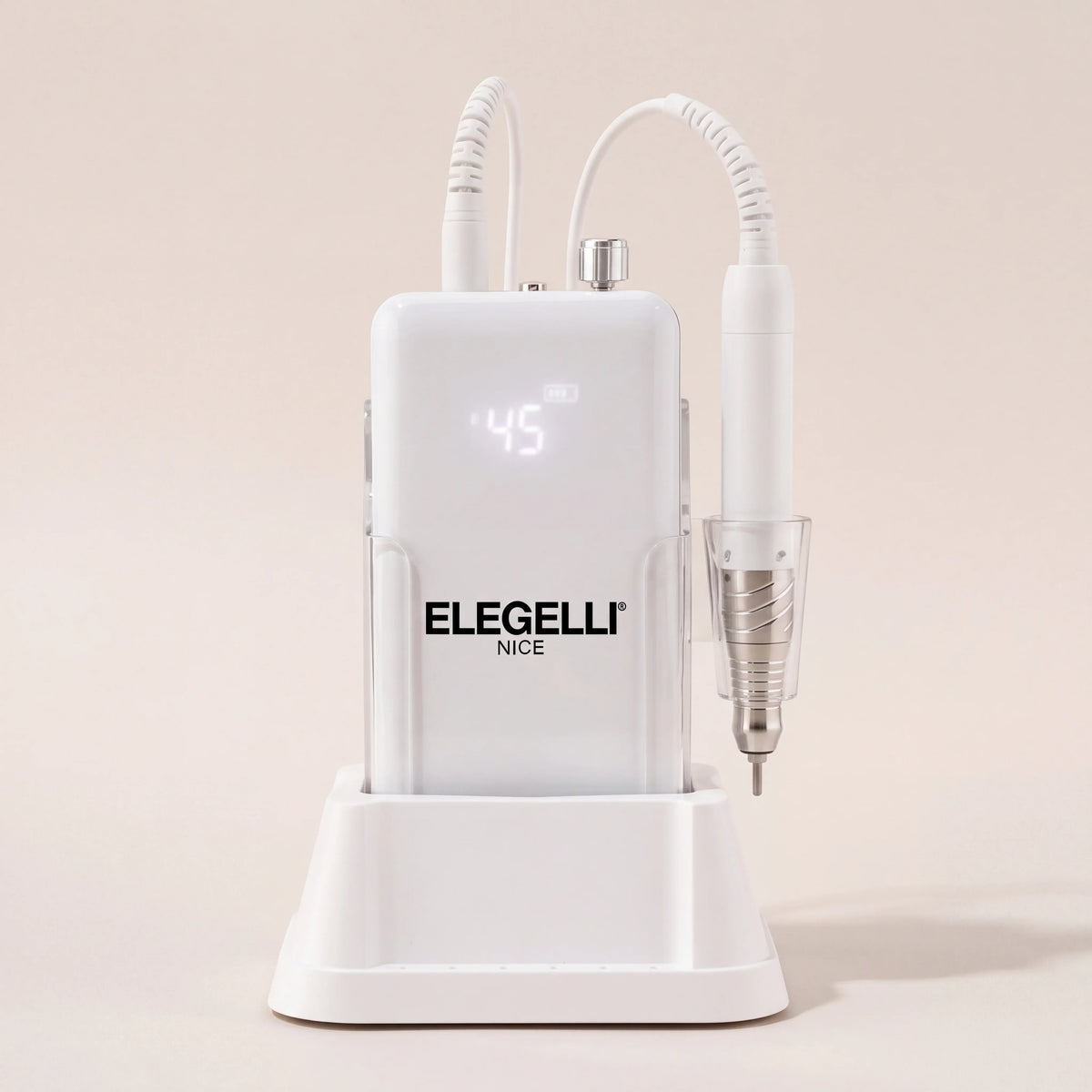
The head decides the job. Its shape tells you where on the nail it belongs, its material tells you what it can remove, and its grit tells you how aggressive it is. The Elegelli cordless nail drill takes 3/32″ bits, which are sold separately, so everything below applies to the bits you choose for it and to the ones you already own.

Carbide nail drill bits are made of tungsten carbide with cross-cut flutes. They shave product into fine shavings instead of grinding it into powder, which is why they are the fastest option for removing acrylic, hard gel, builder gel and gel polish. They run cool when used with light contact, last the longest, and carry a colour ring for the grit.
Diamond nail drill bits are steel heads coated with diamond crystals. They file rather than shave, so they suit the natural nail plate, the cuticle area and the skin: flames, balls and cones for the e-file manicure, larger heads for pedicure. Pushed too hard they heat faster than carbide.
Ceramic nail drill bits come in the same shapes as carbide. They are lighter, transfer less heat to the nail and never rust, which makes them popular for gel removal and with techs who find carbide runs hot. They wear faster than carbide.
Sanding bands are aluminium oxide paper sleeves on a mandrel. They are the disposable option for natural nail prep on the coarse side, for pedicure and for filing acrylic. One band, one client.

Grit is the coarseness of the bit. Carbide and ceramic bits carry a coloured ring on the shank, and most brands follow the dental convention:
A few brands use their own colours, so read the box the first time. Diamond bits follow the same logic without the ring: the finer the coating, the gentler the bit.
| Job | Bit | Grit | Speed |
|---|---|---|---|
| Removing gel polish | Small barrel or tapered barrel, carbide or ceramic; safety bit for beginners | Fine to medium | 15,000 to 25,000 RPM |
| Removing builder gel, BIAB and hard gel | Barrel or tapered barrel, carbide | Medium to coarse | 20,000 to 30,000 RPM |
| Removing acrylic | Large barrel, carbide | Coarse | 25,000 to 35,000 RPM |
| Cuticle work, e-file and Russian manicure | Diamond flame, then diamond ball | Fine | 8,000 to 15,000 RPM |
| Natural nail prep | Safety bit, fine diamond cone or flame, fine sanding band | Fine | 5,000 to 10,000 RPM |
| Shaping extensions, sidewalls and apex | Barrel or tapered barrel, carbide | Medium | 15,000 to 25,000 RPM |
| Under the free edge | Needle or under-nail cleaner | Fine | 5,000 to 10,000 RPM |
| Pedicure: thick nails and calluses | Large barrel, large ball, coarse sanding bands | Coarse | 15,000 to 25,000 RPM |
| Finishing and buffing | Silicone polisher, fine sanding band | Extra fine | 5,000 to 10,000 RPM |
These speeds are starting points. The right speed is the lowest one that does the job without pressure. A bit that needs pushing is either too fine, too worn or spinning too slowly.

Heat on the nail comes from pressure and dwell time, not from speed alone. Light contact at 25,000 RPM heats the plate less than a heavy hand at 10,000 RPM. Keep the bit moving, keep it parallel to the surface you are working, and lift it off the nail every few seconds on thin plates.
Use the direction switch. Forward is the default for right-handed techs; reverse lets left-handed techs work the same way, and lets anyone file the other side of the nail without changing their grip. On the Elegelli nail drill, forward and reverse sit on the control unit, and the overload protection stops the handpiece before it gets warm if a bit is pushed too hard for too long.
On a twist-lock handpiece, turn the collet ring to the open-lock mark, pull the bit out, push the new bit in until the shank is fully seated, then turn the ring back to the closed-lock mark. Never run the drill with the collet open or with a bit half inserted: a bit that is not seated wobbles, and wobble means vibration, heat and a bent shank. A bent bit goes in the bin; it will never run true again.

Sanding bands are single-use: one client, then the bin. Acetone dissolves gel dust but does not disinfect, so it is not a substitute for step three.
A carbide bit lasts months of daily use. Replace it when it starts to grab, squeal, heat the nail or leave streaks in the product. A diamond bit is finished when it polishes instead of filing. Ceramic wears faster than carbide, so check it more often. Sanding bands last one client.
Within the 3/32″ standard, yes: the shank fits any professional e-file, and you can mix brands freely. Between 3/32″ and 1/8″, no. The Elegelli professional cordless nail drill takes 3/32″ bits, like every professional bit you will find on the market.
A fine diamond flame to lift and clean the fold, followed by a small diamond ball to remove the loose skin, both at 8,000 to 15,000 RPM with no pressure.
A small carbide or ceramic barrel or tapered barrel in fine or medium grit, at 15,000 to 25,000 RPM, layer by layer, stopping before the base coat if you are refilling. Beginners should start with a safety bit.
For removal, yes: they run cooler, weigh less and never rust. They wear faster than carbide, so they cost a little more over time.
Yes, with a fine grit, a low speed and a safety or fine diamond bit. Never a coarse carbide on the plate.
Natural nail prep, pedicure, and shaping acrylic, wherever a disposable, hygienic abrasive is better than a bit you have to disinfect.
When they stop cutting cleanly: grabbing, squealing, heat or streaks are the signs. Sanding bands after every client.
How to Choose a Nail Drill in 2026: Pro, Cordless and Beginner Buying Guide
Speed, motor, battery, bits and safety: what to check before you buy a nail drill (e-file) in 2026, with a pro vs beginner comparison and our cordless drill.