


Brittle Nails: Why Nails Peel and Split, and How to Strengthen Them
Why nails peel, split and snap, when to see a doctor, the daily habits that help, and how a rubber base or builder gel overlay protects weak nails as they grow.
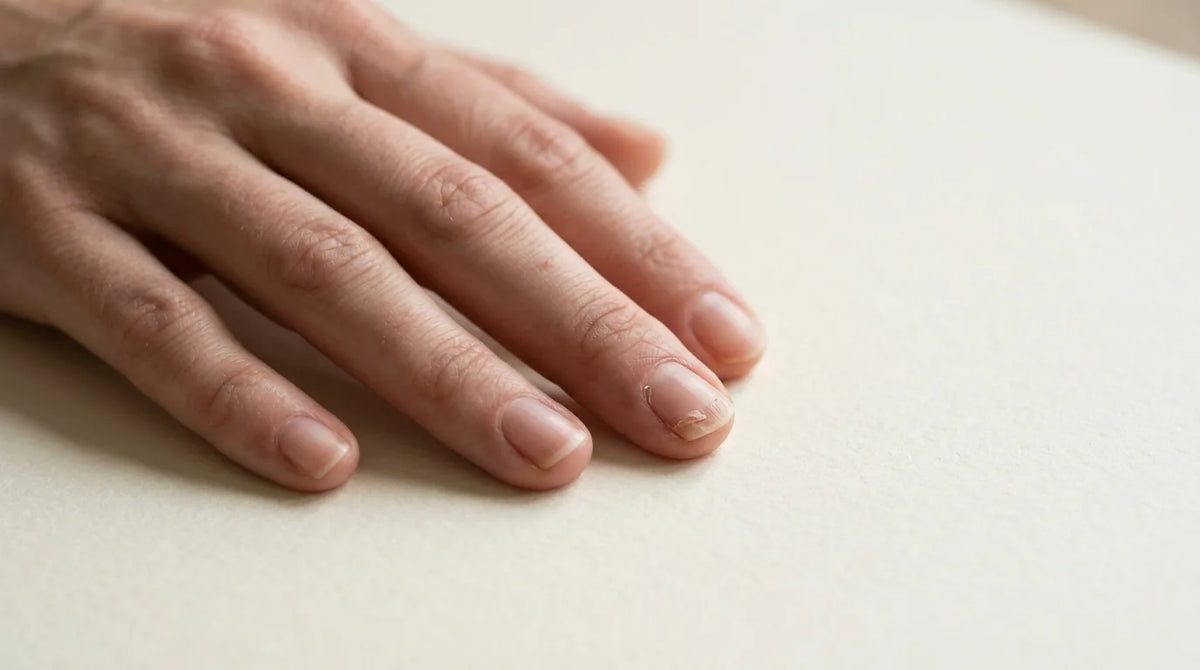

Brittle nails split, peel in layers at the tip or snap at the slightest knock, and for most people the cause is everyday wear: water, detergents, dry air and rough removal of gel. A few changes of habit help, and a thin overlay of rubber base or builder gel protects the nail while a healthier nail grows out.
The nail plate is made of thin layers of keratin, held together by a little water and natural oils. When those layers dry out or wear down, the nail breaks in one of two ways, and many people have a mix of both.
These nails feel rigid and break with a clean crack, often across the tip or as a split running down from the free edge. They are common in winter, with frequent hand washing and with age, because the nail then holds less moisture. What they lack is suppleness, so a product that only makes them harder can leave them even more likely to snap.
Weak nails of this kind bend under light pressure and tear instead of snapping, while the top layers at the tip lift away like thin sheets of paper. Peeling nails usually come from repeated soaking and drying: water swells the layers, they shrink again as they dry, and over time they separate at the free edge.
In most cases, brittle nails come from everyday wear, and several causes often add up.
See a doctor or dermatologist before trying anything at home if:
Brittle nails can sometimes be linked to a health condition, and only a doctor can check for this. If redness, itching, swelling or blisters appear around the nails after a gel manicure, stop using the product and see a doctor. Gel should never go on a nail that is infected, lifting, sore or injured. Our guide to white spots, ridges and lines on nails explains which common marks need medical advice.
Learning how to harden nails comes down to two steps: take away what dries and wears them out, then give them a little moisture every day, with or without gel.
Start with rubber gloves for washing up and cleaning, since hot water and detergent are one of the most common reasons nails peel. After washing your hands, dry them well, nails included, and rub hand cream around the nails.

Once or twice a day, massage a drop of cuticle oil into the cuticle, the nail plate and the free edge. Oil keeps the layers supple, which matters most for hard nails that snap. Our guide to cuticle oil and cuticle care shows how to use it well.
To shape the nails, hold a fine file almost flat against the tip and move it in one direction, from each side towards the centre. Sawing back and forth opens the layers at the free edge and starts new peeling. File a lifted layer away gently, because pulling it tears it further down the nail.

While the nails recover, keep them short and rounded. A short nail catches and bends less, and a rounded or oval tip spreads pressure better than square corners, which split first.
Above all, never pick or peel off gel or polish, even when an edge has lifted: the top layers of the nail come away with it.
If you wear gel, the most useful way to strengthen nails that bend or peel is a protective overlay: a thin layer of rubber base or builder gel over the natural nail. An overlay does not treat or repair the nail. It shields the nail from water and knocks and adds strength, which helps protect the free edge from peeling and splitting while a healthier nail grows out underneath.
An overlay suits nails that are weak, thin or peeling but otherwise healthy. Apply it in thin layers and keep gel off the skin; our guide to gel overlays on natural nails covers the method.
A rubber base is a thicker base that levels the nail and adds strength on a flexible foundation, so it suits a nail that bends. Because it is self-levelling, it also helps correct small irregularities on the surface of the nail. Always finish with a top coat, even when you wear the rubber base on its own.
RB01 Transparent is crystal clear, for a natural look or as a base under colour. The tinted bases can be worn alone as a sheer colour. RB02 Porcelaine is a milky, translucent ivory with a soft porcelain finish, RB03 Cachemire a muted dusty pink for a natural finish, RB04 Pêche a warm peach, and RB08 Lavande a pastel lavender for a cooler tint. All five are HEMA-free, TPO-free and made in France.

On a brittle nail, follow the usual gel steps with a lighter hand at the prep stage.
Of the two overlays, rubber base is the easier choice for beginners and for short nails.
When a rubber base is not enough, builder gel for weak nails is the next step. This thicker, self-levelling gel is made for overlays, strengthening natural nails, extensions and infills, and it gives more structure than a rubber base. It suits nails that bend a lot, nails you want to grow longer, and tips that break even when short.
B003 Milky White is a milky white and B009 Rose Ballerine a fresh ballerina pink, both for a natural, groomed finish. Both come in an airtight press-to-dose jar and cure in 60 seconds under LED or 120 seconds under UV. They are made in France, with no HEMA in the ingredients and TMO instead of TPO.
Builder gel takes more practice than a rubber base: it has to be applied in thin, even layers, because a thick, lumpy layer puts strain on a weak nail. It is removed by filing, so plan an infill when the regrowth shows, usually every few weeks: only the grown-out area and the surface are refreshed, and the natural nail stays protected under the old layer. Our comparison of rubber base and builder gel for natural nails helps you choose between them.
If your nails are only slightly dry and you mainly want colour, a gel polish manicure on Classic Base Coat may be enough: it soaks off in 10 to 15 minutes, which keeps removal gentle, though it adds less strength than an overlay.
Nail hardeners and strengthener polishes are air-dry treatments painted on like ordinary polish. They can help soft, bendy nails, but some formulas make the nail stiffer, so hard, dry nails may snap more easily. Follow the label, and stop if your nails get worse.
| Option | Best for | Strength added | How it comes off | Skill and tools |
|---|---|---|---|---|
| Nail hardener or strengthener polish | Nails that are a little soft, between manicures | Light, reapplied every few days | Nail polish remover | Easy, air-dries |
| Rubber base | Thin, bendy or peeling nails kept short | Medium, on a flexible foundation | Most are filed off; follow the instructions | Moderate, needs a UV or LED lamp |
| Builder gel | Weak nails that need more strength or some length | High, with more structure | Filed off, never soaked | Needs practice and a UV or LED lamp |
Removal is where most of the thinning happens. Whatever the product, never peel, never scrape hard and never file into the natural nail.
For soak-off gel polish on a soak-off base such as Classic Base Coat, file only the shine off the top coat, then wrap each nail in a cotton pad soaked in acetone and foil for 10 to 15 minutes. The gel should lift with light pressure from an orangewood stick; if it resists, wrap it again rather than forcing it. Acetone dries the nails, so wash your hands afterwards and oil the nails and cuticles. Our guide to removing gel polish at home goes through each step.
Builder gel and most rubber bases are filed off; follow the product instructions. Take the bulk down with a medium hand file, change to a finer file near the natural nail, and stop while a thin layer remains, ready for an infill. If you want to go back to bare nails, buff that last film away gently, checking the surface often.
Nail technicians often use an e-file instead. Our Professional Cordless Nail Drill runs quietly with low vibration, reaches up to 45,000 RPM and takes standard 2.35 mm bits. Because it removes product quickly, it needs training: on a brittle nail, keep the speed low, keep the bit moving and never touch the natural nail. Our guide to removing gel nails with an e-file explains the technique.
A fingernail grows about 3 millimetres a month, so a whole nail takes roughly four to six months to grow out. The part that has already split or thinned does not repair itself; it stays that way until it grows out to the tip and is filed off. Keep up the habits and the overlay for several months to protect the new nail growing from the cuticle.
Toenails grow more slowly and take longer. If nothing improves after six months of careful habits, or the nails get worse, see a doctor or dermatologist.
Yes, for weak nails that bend or break, as long as it goes on in thin, well-cured layers and is never peeled off. It protects the nail and adds structure while the nail grows out, without changing the nail itself. For short, thin nails, a rubber base is often enough and easier to apply.
Gel can leave nails thin and peeling, but the damage usually comes from removal: peeling it off, filing into the natural nail or very frequent acetone soaks. Careful prep, thin layers, gentle removal and infills let many people with brittle nails wear gel without making their nails worse.
Yes, a gel overlay can go on nails that peel at the tip but are otherwise healthy. File the loose layers smooth first, take the shine off very lightly and cap the free edge with each layer. Never apply gel to a nail that is lifting, sore, infected or injured; see a doctor instead.
A balanced diet supports healthy nail growth, but food alone rarely fixes nails dried out by water and detergent. Ask a doctor or pharmacist before taking any supplement for your nails.
When you are ready to protect your nails, browse our rubber bases and builder gels to find the overlay that suits them.

White Spots on Nails, Ridges and Dark Lines: What They Mean and Wha…
11 min read
Best Cat Eye Gel Polish: How to Choose the Gel, the Magnet and the …
10 min read
Gel vs Shellac Nails: The Difference, How Long Each Lasts, and Removal
10 min read
How to Stop Biting Your Nails, and How a Gel Overlay Can Help
10 min read
Free delivery from £64
Shipped from Nice, France
Prepared in 1 to 2 business days
For orders placed before 2 pm, Paris time
14-day returns
From the day you receive your order
Secure payment
Encrypted checkout
Nail tech, salon or distributor? Join the Elegelli professional programme for pro pricing.


