


Gel vs Acrylic Nails: Differences, Pros and Cons, and Which Is Better
Acrylic and gel both give strong, long-wearing nails, and chemically they're close relatives. How they're applied, worn and removed decides which one suits your nails.
Acrylic and gel both give strong, long-wearing nails, and chemically they're close relatives. How they're applied, worn and removed decides which one suits your nails.

Gel vs acrylic nails comes down to one main difference: how the product hardens. Acrylic liquid and powder set hard on their own within minutes of mixing, whereas gel stays workable until it's cured under a UV/LED lamp. As a rule, acrylic suits long, sculpted extensions and hands that take a lot of knocks, while gel suits strengthening your own nails and manicures at home. Neither is good or bad for your nails in itself: careful application and removal are what keep them healthy.
Below, we compare durability, finish, nail health, safety and cost, and explain where builder gel and acrylic gel fit in.
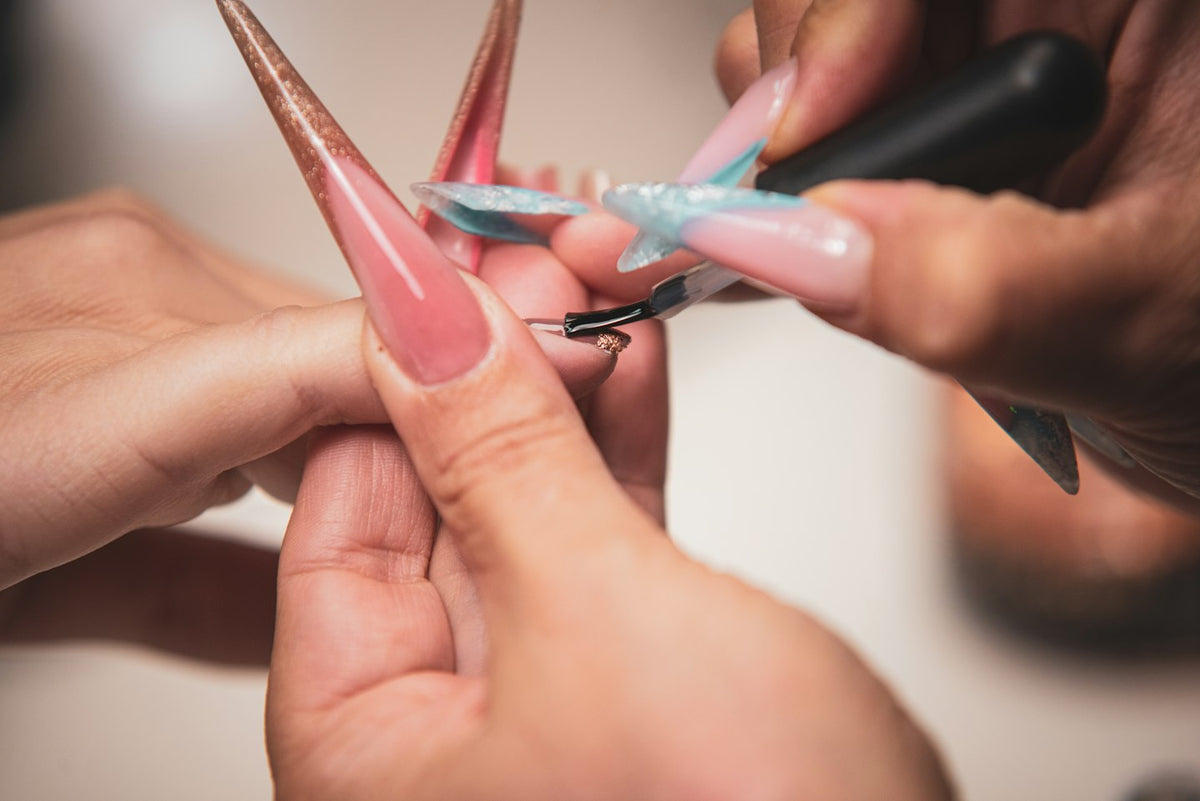
Acrylic is applied one bead at a time. The technician dips a brush in the liquid monomer, draws it through the powder to pick up a bead, then presses it into place. Liquid and powder react as soon as they meet, so each bead has to be shaped before it sets. Length comes from a tip or a form, and the nail is filed to shape afterwards.
Gel comes ready to use from the pot or bottle, and nothing sets until it goes under the lamp. That leaves time to adjust the shape, balance the apex and clean any gel off the skin. For extensions and overlays, the gel to compare with acrylic is builder gel; gel polish only adds colour. Our guide to the types of gel nails covers the full range.
| Acrylic | Builder gel | |
|---|---|---|
| Application | Liquid and powder, pressed into shape bead by bead | Brushed on in layers from a pot or bottle |
| Setting | Sets on its own within minutes | Stays workable until cured under a UV/LED lamp |
| Smell | Strong; needs good ventilation | Low |
| Strength and flexibility | Very hard and rigid | Strong, with a little flex |
| Finish | Filed smooth, then buffed or top-coated; natural in skilled hands | Self-levelling, so less filing; easier to keep thin and natural |
| Removal | Bulk filed down, then soaked off in acetone | Filed off; gel polish soaks off |
| Upkeep | Infill every three to four weeks | Infill every three to four weeks; gel polish redone every two to three weeks |
| Long extensions | Well suited, even extra-long shapes | Suits most lengths; very long shapes need a firm builder |
| At home | Best learned on a course | Easier to learn at your own pace |
Acrylic lasts longer than gel polish, and about as long as builder gel. Gel polish is a thin layer of colour, usually redone every two to three weeks. Extensions and overlays in either material can be worn for months, with an infill every three to four weeks.
The difference lies in how each copes with stress. A long extension acts as a lever whenever the tip catches on a car door or a zip, and at extra-long lengths acrylic's hardness resists that force better. On short or medium nails that bend, gel often lasts longer because it flexes with the nail.

Lifting has the same causes with both: cuticle left on the nail plate, oil on the surface and product touching the skin. An acrylic bead that's too wet, or a gel layer that's too thick or under-cured, also lifts sooner.
Careful prep prevents most of it. Push back the cuticle, remove the dead skin from the nail plate and lightly buff off the shine. For gel, cleanse and dehydrate the nail with Prep Booster, then apply Acid-Free Primer if your nails are oily or prone to lifting.
Keep to the infill schedule, too: as the nail grows, the apex moves towards the tip, and the unbalanced extension breaks and lifts more easily.
Gel is usually the quicker route to a natural result, especially on short and medium nails. Builder gel levels itself before curing, so it's simple to keep thin at the cuticle and side walls. Acrylic in a milky or nude powder can be just as natural when a skilled technician applies it thinly, though it relies more on filing for a smooth surface.
With gel, a milky white builder such as B003 Milky White blurs the line between the pink nail bed and the white free edge. On medium or olive skin, a warm beige such as B010 Beige Trench blends in, and regrowth shows less than with a stronger colour. Filed into a rounded square, an oval or an almond close to your natural length, the nails can pass for your own.

On your own nails, gel is the gentler option for colour and light strengthening, because a thin layer is all they need. Acrylic is designed for structure and length, and it comes into its own on extensions.
With extensions, there's little to choose between them, as both need infills and careful removal. Acrylic has one advantage: it softens in acetone once the bulk is filed down, whereas builder gel has to be filed off carefully. Either way, most of the damage blamed on the product comes from technique:
For thin nails, or nails that bend and peel, gel is the better choice in most cases: they need a fine layer that flexes as they grow. A rubber base such as RB01 Rubber Base Transparent levels into a smooth, flexible coat on short nails, worn clear or under colour. If your nails split or break at the corners, a builder gel overlay with a slight apex gives more support.
Acrylic overlays work well on strong, hard nails, but a rigid layer on a bendy nail tends to lift or crack. For a closer comparison of rubber base and builder gel, read our guide to strengthening natural nails. If a nail is painful, discoloured or lifting from the nail bed, see a doctor before applying anything.
Applied and removed correctly, both are safe for most people and share the same main risk: allergy. Gel and acrylic are both made from acrylates, and repeated contact between uncured product and skin is what triggers it. With gel, the usual cause is gel flooding onto the cuticles; with acrylic, it's liquid monomer or a wet bead touching the skin.
The precautions are the same for both: keep product off the skin and never touch it uncured, including the sticky layer some gels leave after curing. With gel, cure every layer for the full time in its instructions.
If you notice redness, itching, swelling or blisters around the nails, stop using the product and see a doctor or dermatologist. An acrylate allergy usually lasts for life, and switching from gel to acrylic, or the reverse, won't reliably avoid it. It can also complicate later dental and medical treatments that use acrylates.
Acrylic liquid smells strongly and needs good ventilation, and filing either product creates dust that a dust extractor helps control. For salon acrylic, check that the liquid is EMA-based: MMA, a cheaper monomer, is hard to soak off and linked to nail damage. Gel needs a lamp, but the UV exposure from a manicure is generally considered low, and fingerless gloves reduce it further.
Neither is always cheaper, since prices vary widely between countries and salons. A full set of extensions in either material costs more and takes longer than a gel polish manicure, and both need regular infills, which cost less than a new set. In experienced hands, acrylic can be quicker because nothing needs curing, though gel needs less filing at the end.
At home, gel is much easier to manage. Acrylic needs liquid, powder, a dappen dish, an acrylic brush, forms or tips, good ventilation and a practised hand. Gel needs prep products, a base, builder gel or colour, a top coat and a lamp, and you decide when each layer cures. If you need a lamp, our guide to UV and LED nail lamps explains the difference and how long to cure gel.
Builder gel is the gel alternative to acrylic, used for overlays, apex building, extensions and infills. Pot builders tend to be thicker, which helps when sculpting length, while bottle builders brush on like a thick base and suit overlays at home. Our step-by-step guide to using builder gel covers application and common mistakes.
Acrylic gel, also called acrygel, is a putty-like hybrid of acrylic and gel that stays soft until it's cured under the lamp. You shape it with a brush dampened in slip solution, often in dual forms, and file it off like builder gel. It suits anyone who likes sculpting with acrylic but would rather avoid the time pressure and strong smell.
Read next: Builder gel vs acrylic and Polygel vs builder gel.
Most people choose acrylic for length and durability. It holds extra-long stiletto and coffin shapes very well, stands up to hard wear and has the rigid feel many clients like. It also needs no lamp, and a skilled technician can apply a full set quickly.
Gel needs a UV/LED lamp for every layer, and builder gel has to be filed off, which takes time and care. It's also less suited than acrylic to very long extensions. The main health risk is allergy from uncured gel touching the skin, which clean application keeps low.
The healthiest option is a thin manicure on your own nails, such as gel polish or a clear rubber base, prepped lightly and never peeled off. The healthiest nail extensions, in gel or acrylic, are kept to a sensible length, infilled on time and removed patiently.
There's no single replacement, and most newer options are still gel. Builder gel in a bottle makes strengthening overlays quick at home, soft gel tips are full-cover tips fixed and cured with gel, and acrylic gel offers a newer way to sculpt extensions.
Gel is the easier one to learn: you can correct the shape and clean the skin before curing, while acrylic starts to harden as soon as the bead is mixed. Start with gel polish over a rubber base, move on to builder gel overlays, and try extensions once you can place an apex confidently.
If you'd like to try gel on your own nails, our builder gel and rubber base collections include clear, milky and nude shades.
Gel Nails: What They Are, the Types of Gel and How Long They Last
Gel nails can mean gel polish, rubber base, builder gel or hard gel. Learn what each one does, how long it lasts, how it comes off and whether gel harms your nails.
13 min read
Chrome Nails: How to Apply Chrome Powder, Plus 12 Chrome Nail Designs
How chrome powder turns gel into a mirror, how to seal it so the tips don't chip, and 12 chrome nail designs, from silver and gold to pearl glaze and powder-free metallics.
10 min read

Almond Nails: 15 Almond Nail Designs, from Short to Long
Fifteen almond nail designs, from micro French tips to a golden cat eye, each with the shades and steps to recreate it, plus how to file a neat almond at any length.
10 min read

Builder Gel vs Acrylic: Strength, Odour, Removal and How to Switch …
Builder gel vs acrylic compared for nail techs: strength and flexibility, odour, application, removal and nail health, plus how to switch an acrylic client to builder gel.
10 min read
Free delivery from 75€
Shipped from Nice, France
Prepared in 1 to 2 business days
For orders placed before 2 pm, Paris time
14-day returns
From the day you receive your order
Secure payment
Encrypted checkout
Not sure which shade or product to choose? Talk it through with one of our nail experts.
Book my consultationNail tech, salon or distributor? Join the Elegelli professional programme for pro pricing.


