


Best Nail Drill 2027: How to Choose a Professional, Cordless or Beginner E-File
Which e-file to buy for home use, salon work or mobile visits, and the checks that separate a good drill from a poor one, from torque and heat to bits and battery.
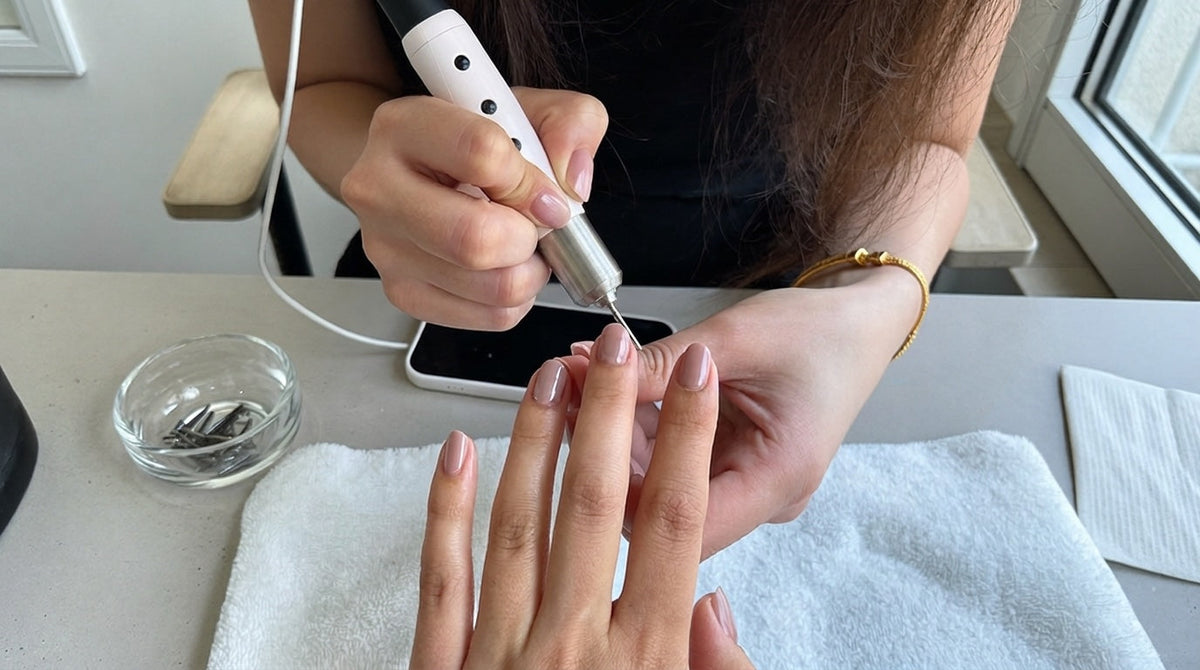

The best nail drill is the one built for the work you'll do with it. If you do your own gel nails at home, you need a smooth e-file that's easy to control at low speed. A nail technician needs a brushless machine that copes with builder gel all day and is still comfortable to hold at the end of it.
A nail drill, also called an electric nail file or e-file, is often the biggest purchase for a nail desk, and the one people most regret choosing in a hurry. Below you'll find a verdict for each kind of user and the checks that separate a good drill from a poor one, followed by safe technique, starter bits and care.
A nail drill is a small rotary tool in two parts: a control unit that holds the electronics and sets the speed, and a handpiece that grips an interchangeable bit. The bit spins at thousands of rotations per minute (RPM) and does the filing. Technicians use it to remove product, shorten and shape enhancements, smooth builder gel and clean the cuticle area, far faster than with a hand file. Models differ in how steadily the bit turns under pressure, how long a cordless battery lasts and how the handpiece feels after hours of work.

That depends on who holds it, for how long and on which product: a home user, a salon technician and a mobile pedicurist each need something different.
At home, control matters far more than power. That control comes from a brushless motor that runs smoothly at low speed, low vibration for fine work near the cuticle, and forward and reverse rotation, since filing the nails on your dominant hand means holding the drill in your weaker one.
It's worth checking first that you need a drill at all. Soak-off gel polish can be soaked off, so a drill earns its place once you wear builder gel, which has to be filed off, or when you want quicker, neater removal. There is a learning curve, so practise on nail tips first.
Our Elegelli Professional Cordless Nail Drill is a salon machine, and more than you need for occasional removal. If you move on to builder gel, though, it is quiet, light and low in vibration, and its speed starts from zero, so you can work slowly and keep a steady hand.
In a salon the drill runs on and off from the first appointment to the last, so the best professional nail drill holds its set speed on hard gel, stays cool in the hand and doesn't tire your wrist. It comes down to three things: a brushless motor, low vibration and enough torque, the turning force that stops the bit slowing as you file.
The Elegelli drill is built around those points, with a brushless motor of up to 85 W, 4.8 Ncm of torque and 0 to 45,000 RPM in both directions. It takes standard bits of any brand, so your existing set still fits, and it comes with a 2-year warranty. The one compromise is regular charging, a small routine some technicians at a fixed desk would rather skip. Our nail technician equipment list covers everything else a working desk needs.
For home visits, pedicures and small desks without a socket nearby, a cordless drill does away with the cable trailing across the client's lap or over the footbath. Check the running time per charge and where the control unit sits while you work: a belt clip keeps it off a crowded trolley.
On the Elegelli drill, the control unit clips to your belt and resists acetone, and one charge gives 8 to 10 hours of running time. Pedicures also call for their own bits, so build a set for feet as well as hands.
Most drills look alike in a photo, so these are the points to check on any model, ours included.

Drills sold for home use are mostly built for occasional filing, while a salon drill has to work on builder gel for hours, client after client.
| Criterion | Home or beginner drill | Professional drill |
|---|---|---|
| Best for | Occasional gel polish removal and shaping | Daily salon work: removal, infills, shaping and prep |
| Motor | Often brushed, with more heat and vibration | Brushless, cooler, quieter and smoother |
| Speed | Lower top speed, may slow down on hard product | A wide range that holds under pressure |
| Torque | Often not stated | Stated in Ncm |
| Bits | Sometimes a 1/8″ shank | Standard 3/32″ (2.35 mm) shank |
| Power supply | Mostly corded | Corded, or cordless with a long running time |
The professional feature a beginner gains most from is a motor that stays smooth and quiet at the bottom of its range, which is where cheaper drills tend to vibrate most. A wide speed range also keeps up as your skills grow, while a basic model soon holds you back.
A corded drill never runs out of battery, which suits a fixed salon desk and long days of back-to-back infills. Its cable, though, ties the control unit to a socket and limits how freely you move around the client.
A cordless nail drill goes wherever you work, from the pedicure chair to a client's home, as long as the battery keeps up with your schedule. Ours charges fully in 3 hours by USB-C or on its smart charging base, so a night on the base has it ready for the next day.

When you remove gel, stop at a thin layer of base and leave it in place, so you don't thin the natural nail. Our guide to removing gel nails with an e-file takes you through it. Cuticle work takes the most practice, and our Russian manicure guide covers drill work in that area.
A starter set covers most services: a carbide or ceramic barrel for removal, a tapered bit or cone for the sidewalls, a flame or safety bit for the cuticle area, and a mandrel with sanding bands for the surface. Beginners should start with a safety bit, whose smooth, rounded top is less likely to catch the skin.
Bits are not included with the Elegelli drill and we don't sell them, so you'll buy a set separately. Any standard 3/32″ bit fits, whatever the brand, but check that the shank is straight and true: a bent one wobbles and makes the handpiece vibrate. Our nail drill bits guide explains every shape and the grit colour code.

Our drill is a professional cordless e-file for manicure and pedicure, made for nail technicians in the salon or on the move, and for home users who want a tool they won't outgrow.

The drill saves the most time on builder gel, which is removed by filing, never by soaking. At an infill, file down the grown-out product and blend the regrowth line with a carbide bit, then rebuild the apex with a self-levelling builder gel such as B003 Milky White. Our guide to builder gel infills goes through each step, and every shade is in the builder gel collection.
Daily care is simple and mostly means keeping liquid away from the electronics.
The best nail drill for beginners is a brushless model that runs smoothly at low speed, with low vibration, forward and reverse rotation and a standard 3/32″ collet. Start with a safety bit and practise on nail tips until you feel confident.
A good cordless drill can handle full salon work, provided it has a brushless motor, enough torque and a battery with a long running time. A corded model still makes sense at a fixed desk if you never want to think about charging.
It depends on the job, and most work happens well below the maximum. As a rough guide, the natural nail and the cuticle area are worked slowly, often at 5,000 to 10,000 RPM, while gel removal and shaping sit at around 10,000 to 20,000 RPM. Higher speeds are for hard product in experienced hands, so a wide, stable range matters more than the top figure.
Yes. Nail drill, electric nail file and e-file are three names for the same tool, so the best electric nail file is judged on the same points as the best nail drill: torque, motor, heat, bits and battery.
Yes, with a fine bit, a low speed and light pressure, for example to take the shine off before gel or to clean around the cuticle. Keep coarse bits and high speeds for product, because they thin the nail plate quickly. If a nail feels hot or sore, stop straight away.
That varies with the model and its battery capacity. The Elegelli drill gives 8 to 10 hours of running time per charge from a 2,500 mAh battery, meaning hours with the motor turning, and recharges fully in 3 hours.
You'll find the drill and its full specifications in our nail drills collection, and the colours to wear over a well-prepped nail in our gel polish range.
Nails for Men: The Men's Manicure, Step by Step
10 min read
French Tip Toes: How to Do a French Pedicure with Gel, Plus 10 Ideas
11 min read

Carnival Nails: 14 Bright Ideas with Glitter, Colour and Shine
12 min read
Neon Nails: 12 Bright Ideas and How to Make Neon Colours Pop
11 min read
Free delivery from R$ 430
Shipped from Nice, France
Prepared in 1 to 2 business days
For orders placed before 2 pm, Paris time
14-day returns
From the day you receive your order
Secure payment
Encrypted checkout
Nail tech, salon or distributor? Join the Elegelli professional programme for pro pricing.


