TPO-Free Gel Polish: What the TPO Ban Means and How to Choose Your Gels
TPO has been banned from EU cosmetics since 1 September 2025. Find out how to spot it on a label and how to pick TPO-free gels that still cure fully, from base coat to builder gel.
by Anastasia Kovalenko
TPO-free gel polish is made without TPO, a photoinitiator that has been banned from cosmetics in the EU since 1 September 2025. To keep it out of your manicure entirely, every layer from base to top coat needs to be TPO-free, and each one still has to cure fully under your lamp.
The simplest way to get there is to take your base, colour and top coat from one TPO-free range, so you only have one brand's labels to read. At Elegelli, our gel polish, base coat, top coats and rubber bases are all formulated without TPO or HEMA, and our builder gels use a different photoinitiator called TMO.
This guide explains what TPO does, how to spot it on a label and how to make sure a TPO-free gel cures properly, then suggests products for each step.
What is TPO in gel polish?
TPO is short for trimethylbenzoyl diphenylphosphine oxide, one of the photoinitiators that make gel cure. Gel stays liquid until light from a UV or LED lamp reaches the photoinitiator, which sets off the reaction that hardens it into a solid film. TPO responds well to both UV and LED light, so it was widely used in nail gels.
Every gel that cures under a lamp needs a photoinitiator, so a TPO-free gel uses a different one, and the words "TPO-free" on a bottle say nothing about how well it cures. That depends on the formula and on your lamp.
Is TPO banned? What the EU ban means for your gels
In the EU, yes: TPO has been banned from cosmetics since 1 September 2025, and that covers gel polish, builder gel, base and top coats. Our article on the EU ban on TPO in cosmetics gives the background, and UK readers will find the position there in our guide to the TPO ban in the UK for nail professionals.
Other countries set their own rules. Wherever you live, though, check the bottles you already own: an older base or top coat, or a gel ordered from outside the EU, may still list TPO.
How do I know if my gel polish has TPO?
Read the full ingredient list (the INCI list) on the bottle, box or leaflet. If it includes trimethylbenzoyl diphenylphosphine oxide, the gel contains TPO, whatever the front of the box says.
Don't mistake it for ethyl trimethylbenzoyl phenylphosphinate, or TPO-L: the names are close, but TPO-L is a different ingredient, as our guide to the difference between TPO and TPO-L explains.
Check rubber base, builder gel and liner gels too, since a TPO-free colour over a base that contains TPO leaves TPO in the manicure. HEMA-free and TPO-free are also separate claims, and a gel can carry one without the other; our guide to HEMA-free gel polish covers the HEMA side of the label.
On the label
What it means
What to do
Trimethylbenzoyl diphenylphosphine oxide
The gel contains TPO
Choose another gel
Ethyl trimethylbenzoyl phenylphosphinate
TPO-L, a different photoinitiator
Not TPO; see our TPO and TPO-L guide
"TPO-free" on the front, no ingredient list
The claim cannot be checked
Ask for the full list or the safety data sheet
"HEMA-free" and "TPO-free", confirmed by the list
Both removed, other acrylates still present
Keep it off your skin, as with any gel
Does TPO-free gel polish cure properly?
Yes. A well-made TPO-free gel cures fully as long as you follow the curing time in its instructions and use a lamp that suits it, since each photoinitiator reacts to its own range of light. When a new gel gives trouble, the usual causes are a mismatched lamp, coats that are too thick, or a curing time carried over from an old product.
Thin coats cure fully. Thick coats can wrinkle and stay soft underneath.
Under-cured gel stays soft or rubbery, wrinkles, or starts lifting within days. To find the cause, do a test nail with a thin coat and the full curing time, and cure your thumbs on their own so they lie flat under the light. Dark, dense shades need the most care, since pigment stops light reaching the bottom of a thick coat.
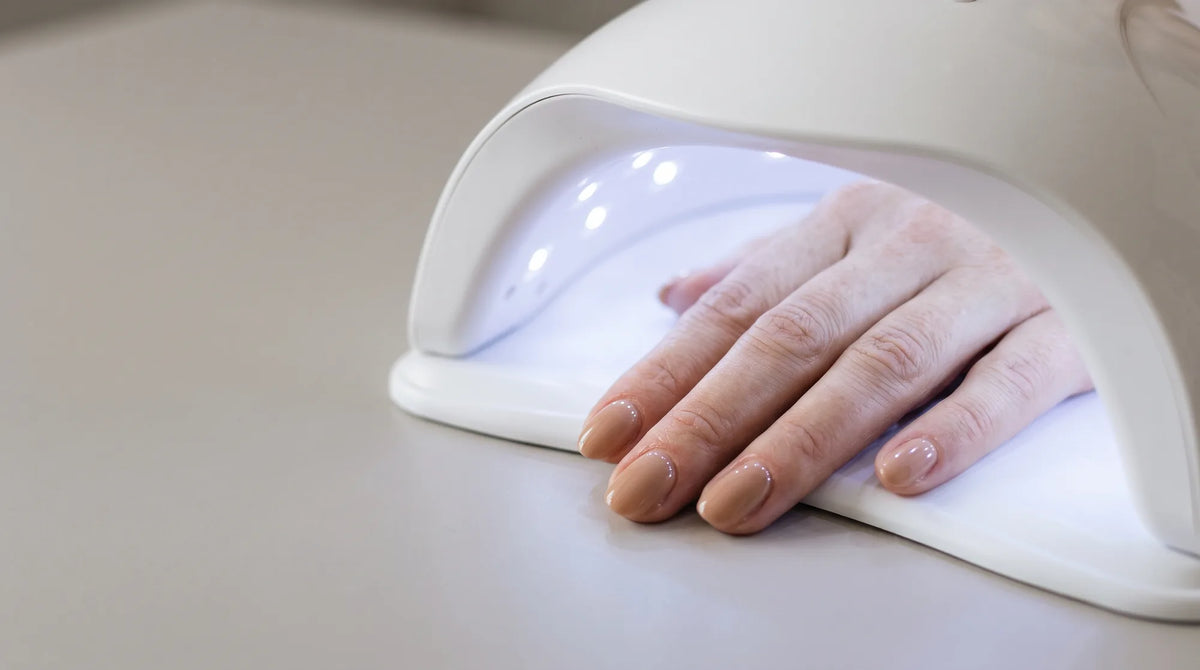
Elegelli does not sell lamps, but our gel polish cures under any UV or LED lamp without wrinkling and without a heat spike, the sudden burning feeling some gels cause under the light. If you need a lamp, look for a UV/LED model wide enough for four fingers to lie flat, with no shadow at the sides of the nails and timer settings that match your gels' instructions. Our comparison of UV vs LED nail lamps explains the difference.
How to choose a TPO-free gel polish brand
Once TPO is off the label, judge a brand first on what it tells you about its formulas. These checks apply wherever you shop.
A full ingredient list for every product. That means base, top coat and builder gel as well as colours, with a safety data sheet on request.
Curing times for UV and LED. Without them, you are left guessing how long each layer needs.
Notice of formula changes. A reformulated gel can need a different curing time, so the brand should tell you when it happens.
Then think about your own nails. Beginners find it easiest to keep base, colour and top coat in one range, with a base that does not flood the cuticles and a no-wipe top coat. Thin or weak natural nails benefit from a rubber base or builder gel that adds strength. Salons need consistent formulas, builder gel that keeps its texture in the jar and a safety data sheet on file for each product.
HEMA and TPO-free gel polish: what it means for allergies
A gel free of both HEMA and TPO still contains other acrylates and can cause an allergic reaction, as the warning on our labels says. Leaving out HEMA takes away one major allergen, but the risk of allergy remains.
Uncured gel on the skin is the main cause of gel allergy, so keep gel off the skin and cuticles, wipe away any spill before you cure and give every coat its full curing time. If redness, itching, swelling or blisters appear around the nail, stop using the product and see a doctor or dermatologist.
TPO-free nail products for every step
Every gel below is made in France and notified on the EU and UK cosmetics portals (CPNP and SCPN).
A deep espresso brown in glossy gel, on short squoval nails.
TPO-free base coat and rubber base
Classic Base Coat suits healthy natural nails and anyone who removes their gel at home. It levels flat without flooding the cuticles, holds for up to 21 days without lifting or peeling, soaks off in 10 to 15 minutes and works under any brand of gel polish.
Thin, weak or ridged nails do better on RB01 Transparent, a thicker rubber base that levels the nail plate and adds strength. It takes a little more control, so work with a small bead and keep it well back from the cuticle. The tinted shades in our rubber base collection can also be worn alone as a sheer colour.
Most of our gel polish shades cover in one coat and last up to three weeks without chipping or lifting with a base and top coat. For the office, try 075 Beige, a soft natural beige. Pale shades like this can streak when the brush drags too much product, so build them in two thin coats, which also cure more reliably than one thick coat.
For autumn and winter, 010 Coffee is a deep, rich brown that suits gold jewellery, and 019 Hibiscus is the fresh, vibrant shade in both our kits. All our colours are soak-off, and we never change a formula silently. The full range is in our gel polish collection.
Diamond Top Coat is no-wipe, so there is no sticky layer to remove. It cures to a hard, scratch-resistant finish with a mirror shine that lasts to fill day, about three weeks, and it does not yellow, even over whites, nudes and French manicures.
For a velvet finish, switch to Matte Top Coat: it is streak-free in one coat, stays matte until fill day and resists the grease marks and stains that usually spoil matte nails. It is no-wipe too, and suits deep shades such as 010 Coffee better than very pale ones, which can turn chalky. Both are in our top coat collection.
Builder gel and hard gel can contain TPO too, so read their labels the same way. Ours use TMO in place of TPO and list no HEMA in their ingredients. They come in a 30 mL airtight jar: press to dose, or unscrew it to work with a brush, and the gel does not thicken inside. It is self-levelling, cures in 60 seconds under LED or 120 seconds under UV, and holds for 28 days and more without lifting when applied correctly.
Builder gel is for structure: overlays on natural nails, extensions on forms or tips, and infills. For a clean milky finish, worn alone or under a fine French line, use B003 Milky White, or pick the warm beige of B010 Beige Trench to keep regrowth discreet on short nails. The trade-off is removal: builder gel is filed off, never soaked, so if you like to soak off at home, gel polish over a base is easier. Every shade is in our builder gel collection.
The Gel Polish Discovery Kit brings together the three gel steps: Classic Base Coat, 019 Hibiscus and Diamond Top Coat. The Deluxe Manicure Pro Kit adds the prep stage, with Prep Booster to take oil and moisture off the nail plate and our Acid-Free Nail Primer, which helps stop lifting even on oily nails. In both kits the three gels are formulated without TPO. Neither includes a lamp, and each has one colour, so add 075 Beige for a neutral to wear to work.
A first gel manicure at home. The Gel Polish Discovery Kit, plus a UV or LED lamp.
Nails that lift or feel oily. The Deluxe Manicure Pro Kit, which adds Prep Booster and primer to the three gel steps.
Replacing gels that contain TPO. Classic Base Coat and Diamond Top Coat first, since they go into every manicure, then colours such as 075 Beige or 010 Coffee.
Thin or weak natural nails. A layer of RB01 Transparent under your colour, or B010 Beige Trench builder gel if you also want length and are happy to file it off.
Salons and nail technicians. For overlays and infills, B003 Milky White and B010 Beige Trench, plus Classic Base Coat, Diamond Top Coat and Matte Top Coat for gel polish clients.
Frequently asked questions
Is TPO-free gel polish better?
In the EU, it is now the only option, since TPO is banned from cosmetics. Wear comes down to the formula and the application: ours lasts up to three weeks without chipping with a base and top coat. Going TPO-free does not remove the risk of allergy either, because gel polish contains acrylates.
What is the difference between TPO and TPO-L?
They are two different photoinitiators. TPO is trimethylbenzoyl diphenylphosphine oxide, banned from EU cosmetics since 1 September 2025, while TPO-L is ethyl trimethylbenzoyl phenylphosphinate. Check the full name on the label before you decide that a gel contains TPO.
Which gel polishes have TPO?
Any gel whose ingredient list includes trimethylbenzoyl diphenylphosphine oxide. Since the ban, gels sold as cosmetics in the EU should not contain it, so the bottles most worth checking are older ones and gels bought from outside the EU, bases and top coats included.
Is TPO-free builder gel available?
Yes. Builder gel can be made with other photoinitiators, and ours use TMO in place of TPO, with no HEMA in the ingredient list.
Once your base and top coat are TPO-free, pick the colours to wear over them from our gel polish collection.