


White Spots on Nails, Ridges and Dark Lines: What They Mean and What to Do
White spots usually grow out and fine ridges are common, but a new dark line needs a dermatologist. What each nail mark means, and when gel can go over it.


White spots on nails are usually the trace of a small knock to the base of the nail, and they grow out by themselves over the following months. Fine lengthwise ridges are just as ordinary. A few changes do need a doctor, though, and a new dark line along a nail should be shown to a dermatologist promptly.
This guide takes each sign in turn, says what tends to lie behind it and when to have it checked, then explains when gel can go over a marked nail. We make nail products and are not a medical source, so ask a doctor or dermatologist about any change that is new, painful or worrying.
The usual cause of white spots on nails is a minor injury to the matrix, the area under the skin at the base of the nail where the nail plate is formed. A knock against a desk, a finger caught in a drawer or firm pressure on the cuticle disturbs a few of the cells being made there. Those cells surface weeks later as a small white dot or dash, by which time most people have forgotten the bump.

From then on the spot travels towards the tip as the nail grows, until it is clipped off with the free edge. It sits inside the nail plate, so buffing, oil and cream won't remove it, and nothing needs doing while it grows out.
White spots are widely blamed on a lack of calcium, but that is a myth. The ordinary scattered spot is a growth mark left by a knock, and such spots come and go on healthy nails.
Larger white areas are a different matter. A patch that spreads, covers the whole nail or comes with a crumbling surface should be shown to a doctor, since a minor injury doesn't explain it.
Vertical ridges on nails, the fine raised lines that run from cuticle to tip, are very common and tend to show more with age and dryness. They stand out most when low sunlight or a desk lamp rakes across the nail. Fine, even ridges on most of your nails are generally nothing to worry about.

It is tempting to buff ridges flat, but that is the one thing to avoid. A natural nail is thin, and every pass of the buffer takes away a little of that thickness. The ridge is formed at the matrix along with the rest of the nail, so new growth arrives ridged again. Repeated buffing only leaves the nail thinner and quicker to split.
What does help is moisture. Massage a drop of cuticle oil into the nail and the skin around it every evening, and wear gloves for washing-up and cleaning. The ridges won't vanish, but a well-oiled nail looks smoother and is less inclined to split. Our guide to cuticle oil and cuticle care sets out the routine.
Do show a doctor any ridge that is new and deep, sits on one nail only, splits the nail or arrives with other changes.
Horizontal ridges on nails are grooves or dents that run from one side to the other, and they form when nail growth is briefly disturbed. That can follow an illness, an injury to the finger or rough manicure work at the cuticle, which sits right above the matrix. As with a white spot, the groove appears some weeks afterwards and then moves towards the tip.
A single dent on one nail after a bump or a heavy-handed manicure simply grows out. If grooves show on several nails at once, or new ones keep appearing, see a doctor, because the cause is then unlikely to be a one-off injury.
A brown or black line that runs the length of a nail must be shown to a dermatologist promptly if it is new, changing, wide or on one nail only. Don't wait to see whether it grows out, and don't paint over it in the meantime. Some causes of a dark band are serious and best caught early, and only an examination can show what is behind yours. When you first notice the line, take a clear photo in daylight so that the doctor can judge whether it has changed.
Injuries leave dark marks as well, and these behave differently. Small, short splinter-like marks, or a bruise under the nail after a trapped finger, usually move forward with the nail until they reach the tip. If you can't recall an injury, if the mark stays in place while the nail grows, or if you are in any doubt, see a doctor.
Yellow nails after nail polish are usually just stained. Strongly pigmented colours, reds and dark shades in particular, leave some pigment in the top layers of the nail when they are worn without a base coat. The tinge shows once the colour comes off, is fairly even across the nail and fades as the nail grows.
Because the stain sits in the nail itself, buffing it away would thin the nail, so it is better to leave it alone and prevent the next one. A base coat does that by putting a layer between the pigment and the nail. For gel manicures, ours is the Classic Base Coat, which works under any brand of gel polish and soaks off in 10 to 15 minutes.
Some yellowing has nothing to do with polish. A nail that is thick, crumbly, lifting from the nail bed or discoloured without ever having been painted needs a doctor, and covering it with colour only delays the visit.
Yes, provided the nail is healthy and intact: firmly attached to the nail bed, free of pain and surrounded by unbroken skin. White spots from a knock and fine vertical ridges are cosmetic marks, so gel can go over them, although it covers them without treating them.
A white spot disappears under any opaque colour, whereas a sheer nude only softens it. Ridges take a little more thought, because gel polish is thin enough to follow every line, and pale, glossy shades show the unevenness most. The answer is a rubber base, which is thicker and self-levelling, so it evens out small irregularities and adds strength to the natural nail.
Work a very thin first coat into the nail and cure it, then float a slightly fuller second coat over the surface, let it settle for a few seconds and cure again. Follow the curing time in the instructions and keep the gel off the skin. The ridges are still there underneath, but the surface you paint on is smooth.
If colour is going on top, the crystal-clear RB01 Transparent sits beneath any shade. For a natural finish, the muted dusty pink of RB03 Cachemire can be worn alone as a sheer colour under Diamond Top Coat, our no-wipe top coat. Both rubber bases are HEMA-free, TPO-free and made in France, and our rubber base gel guide covers the technique step by step.
Gel has firm limits, though. It never goes over a nail that is infected, lifting, damaged or painful, because a hard coat hides the problem and delays the care the nail needs. Nor should colour ever hide a dark line before a doctor has seen it.
Some of the marks described above are made at the nail desk, and three habits are usually behind them.
Heavy pressure from a metal pusher or an e-file bit reaches the matrix just under the skin, and can leave white spots and horizontal dents that show up later. Hold the pusher almost flat and slide it back with light pressure, lifting only the thin film of dead skin that clings to the nail plate. Living skin is never cut.
Gel grips a clean, matt surface, and a few light passes with a fine buffer are enough to take off the shine. Filing harder in the hope of better adhesion, or filing into the nail during removal, thins the plate and leaves it bendy and tender. After buffing, let cleansing do the rest. Our nail dehydrator, Prep Booster, takes oil and moisture off the nail plate without leaving it dry, white or brittle. For better adhesion, follow it with Acid-Free Nail Primer rather than filing harder: it helps stop lifting even on oily nails, with no burning or stinging.
A lifted edge is hard to leave alone, but peeling gel takes the top layers of the nail with it. The result is rough, chalky white patches on the surface, followed by nails that flake and bend. If a patch like this spreads or the nail starts to crumble, show it to a doctor.
Soak-off gel polish should be soaked or filed away patiently, as our guide to removing gel polish at home explains. Most rubber bases are filed off, so follow the product instructions and stop short of the natural nail. If rough removals have already left your nails thin, our advice on how to harden your fingernails covers their care while they grow back.
A few signs should never be left to grow out. Have any of the following seen by a doctor or dermatologist.
Remove any gel or polish before the appointment, so that the whole nail can be examined.
Most white spots on nails come from a small knock or pressure on the matrix, at the base of the nail. They show up weeks later and grow out with the nail. White patches that spread or crumble need a doctor.
No, that is a common myth. The typical white spot is a mark left by a minor injury to the base of the nail, and it grows out by itself.
Fine vertical ridges are very common and tend to show more with age and dryness. Horizontal ridges form when nail growth is briefly disturbed, and a doctor should see them if they affect several nails or keep returning.
Have it checked as soon as you notice it. A brown or black line along a nail that is new, changing, wide or on one nail only should be examined by a dermatologist promptly. The same goes for any dark mark you are unsure about.
Pigment from dark or strongly coloured polish stains the top layers of the nail when it is worn without a base coat, and the stain fades as the nail grows. Nails that are yellow and also thick, crumbly or lifting need a doctor.
For healthy nails that need a smoother surface or a base layer under dark colour, start with our rubber base and base coat collections.
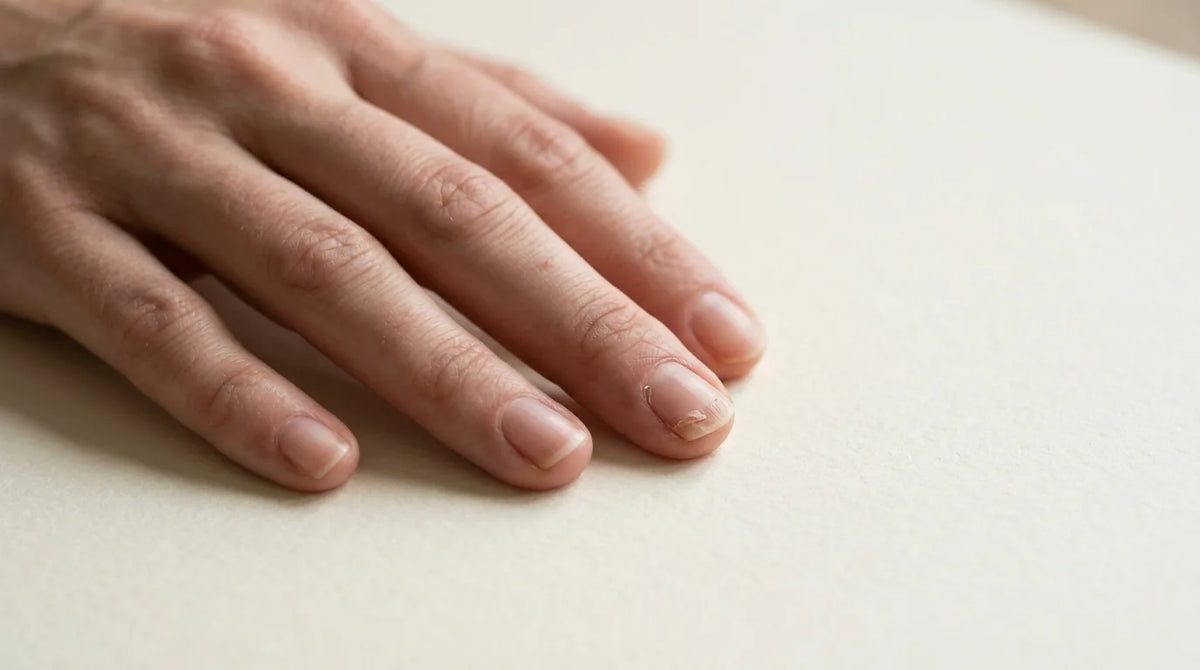
Brittle Nails: Why Nails Peel and Split, and How to Strengthen Them
12 min read
Nails for Men: The Men's Manicure, Step by Step
10 min read
French Tip Toes: How to Do a French Pedicure with Gel, Plus 10 Ideas
11 min read
Carnival Nails: 14 Bright Ideas with Glitter, Colour and Shine
12 min read
Free delivery from Dhs. 320
Shipped from Nice, France
Prepared in 1 to 2 business days
For orders placed before 2 pm, Paris time
14-day returns
From the day you receive your order
Secure payment
Encrypted checkout
Nail tech, salon or distributor? Join the Elegelli professional programme for pro pricing.


