


How to Stop Biting Your Nails, and How a Gel Overlay Can Help
Why people bite their nails, what dermatologists advise, and how a thin gel overlay on very short nails makes biting harder while the nails grow.
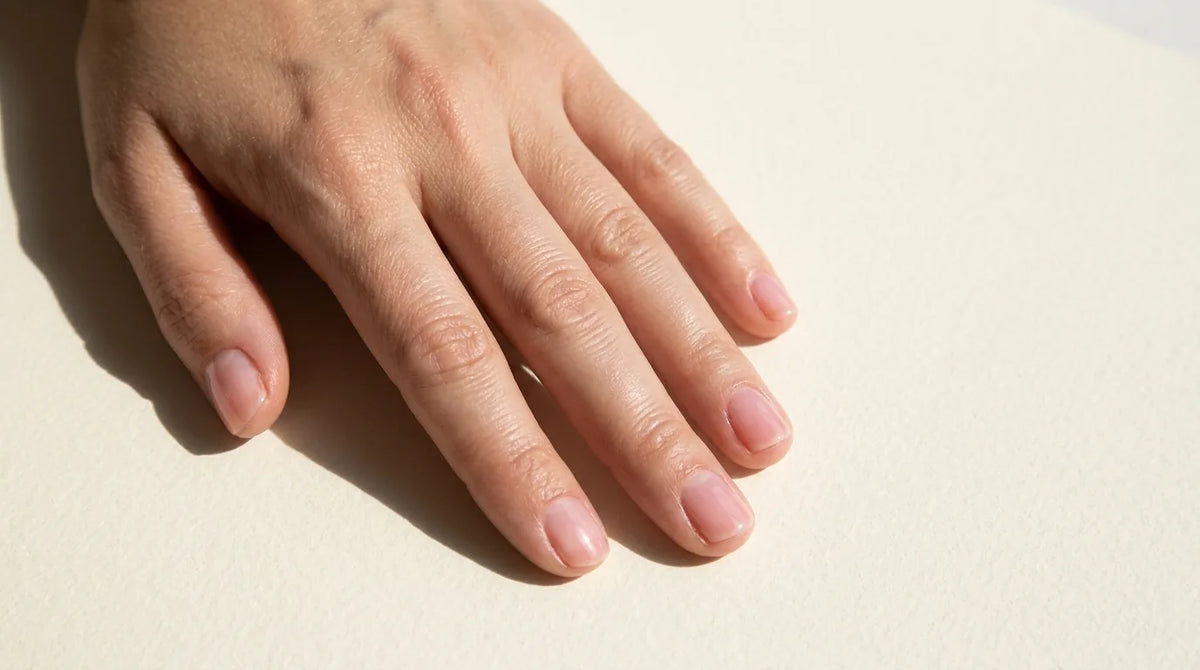

Learning how to stop biting your nails starts with three things: knowing when and why you bite, keeping your nails short and smooth, and putting something between your teeth and the nail. A thin gel overlay is one way to do the last part, because it makes the nail thicker and harder to bite through.
Below are the medical facts, the overlay method for very short nails and a three-month plan.
Nail biting has a medical name, onychophagia, and a public health service describes it as a common habit that relieves stress. The cause of chronic biting is not fully understood, but biting tends to happen in moments of stress, excitement, boredom or inactivity. It can also be learned from family members.
Physical triggers matter too: a hangnail or a rough corner can be enough to start. Chronic biting often has a self-soothing quality, and healthcare providers classify it as a body-focused repetitive behaviour, in the same group as lip biting and cheek chewing. Only in rare cases may nail biting be a symptom of obsessive-compulsive disorder; for most people it is a habit.
About half of children aged 10 to 18 bite their nails at some point. Most people stop on their own by the age of 30, although some carry on as adults.
Repeated biting causes small injuries around the nail that let bacteria, viruses and fungi in. The fingertips can turn red and sore, the cuticles can bleed, and the skin fold around the nail can become infected, a condition called paronychia.
Over time, damage to the nail bed and cuticle can lead to uneven growth, ridges and hangnails. Long-term biting can also harm the tissue that makes the nail grow and leave it misshapen. Chronic biting can carry germs from the mouth to the fingers and back, and dentists warn that it can chip teeth and affect the jaw.
The American Academy of Dermatology gives six tips:
Other sources add that keeping a record of when you bite makes you more aware of it, and that small, realistic goals can help. If you cannot stop alone, a therapist can teach habit-reversal training, which has worked in some cases, and therapy can ease the shame that often comes with the habit. One dermatologist stresses that there is no quick fix and that the reasons behind the habit need attention too.
A gel overlay is a thin layer of rubber base or builder gel cured over the natural nail, with no added length. In salon practice it can help in three ways: the nail becomes thicker and harder to bite through, it has no rough edge for the teeth to catch, and the natural nail keeps growing underneath.
A manicure you have paid for or done with care is also one you are more likely to want to keep. A medical review reports that professional manicures can reduce biting in people who want to preserve them, and a public health service notes that artificial nails may stop you biting and protect the nails as they grow out. Neither source mentions gel by name, and an overlay does not stop the habit, although it can make biting harder for some people. Our guide to the gel overlay on natural nails explains the technique.
Yes, as long as the skin around the nail is intact and enough nail plate remains. Gel needs a nail plate to hold on to, and a nail bitten so far down that the nail bed shows gives it almost nothing to grip.
A nail technician checks the hands first: a cut, a bleeding cuticle, redness, swelling, pain or pus all mean no gel, because the skin needs to heal and a possible infection needs a doctor or a pharmacist. The same applies to a nail that is lifting from its bed, discoloured or thickened. Dermatologists also advise against artificial nails for people prone to fungal infections or with brittle nails, and against using them to cover nail problems, which they may make worse.
A nail that is just short, with unbroken skin around it, can take an overlay. A nail that biting has left ridged or misshapen is shown to a doctor before any overlay, and if you are unsure, hold off.

Either product works on a very short nail: a rubber base levels the nail and gives a flexible foundation, and builder gel adds structure and strength. Always start with a smooth edge, because a ragged corner is the first thing the teeth find.


For the layer itself, RB01 Transparent is crystal clear, while RB03 Cachemire, a muted dusty pink, and RB09 Guimauve, a marshmallow pink, can be worn alone as a sheer colour. Among the builder gels, B009 Rose Ballerine is a fresh ballerina pink, B006 Magnolia a delicate light pink and B003 Milky White a milky white. Our rubber base gel guide and builder gel guide go into more detail.
Fingernails grow about 3 millimetres a month, so a whole nail takes roughly four to six months to grow out. There is no reliable timeline for a bitten nail, and long-term biting can leave it permanently shorter, so set your goals in stages.

Between infills, our guide to cuticle oil and cuticle care explains how to look after the skin around the nails.
Peeling or biting off gel takes layers of the natural nail with it, leaving it thinner, and dermatologists advise against picking off gel. If an edge lifts or breaks, file it smooth so nothing catches, then have the overlay repaired or filed off. Builder gel and most rubber bases are filed off, so follow the product instructions and keep the filing light near the natural nail.
A salon's main advantage is that a technician checks the skin and nail plate before starting. A thin overlay on a tiny nail also takes a steady hand.
At home, you need the products above and a UV or LED nail lamp, which Elegelli does not sell. Our rubber bases are HEMA-free and TPO-free, and our builder gels list no HEMA and use TMO, a different photoinitiator from TPO. They still contain other acrylates and can cause an allergic reaction, so keep gel off the skin, and if redness, itching, swelling or blisters appear, stop and see a doctor. Because repeated gel manicures can increase the risk of skin cancer and premature skin ageing on the hands, dermatologists advise a broad-spectrum sunscreen of SPF 30 or more, or dark fingerless gloves.
See a doctor if you have tried to stop several times and the biting continues, because for some people it can be a sign of a deeper emotional problem. Seek medical care too if biting is damaging the nail or the skin around it, or if you see signs of infection such as redness, pain or swelling, and do not pick at an infected area.
A mental health professional can help if biting causes you shame, anxiety or low self-esteem, or affects your social life. For a child who bites, talk to your doctor.
No. A gel overlay can make biting harder for some people, which can help, but it goes alongside the habit changes dermatologists advise.
It can help: it adds structure and strength to the natural nail, and like any overlay it makes the nail thicker and harder to bite through. It needs regular infills and is filed off, so it suits people who can keep them up. It goes on only over intact skin.
They keep growing, but not always to their old shape. Long-term biting can damage the tissue that makes the nail, so some nails stay shorter or uneven, and there is no reliable timeline for regrowth.
It can be. Repeated biting can make the skin sore, let germs into small wounds and lead to infections around the nail, and over time to ridges, misshapen nails and chipped teeth.
Keep the nails short and smooth, learn your triggers, keep your hands busy and stop on one set of nails first. If nothing works, see a doctor.
Start with a thin overlay from our rubber base or builder gel ranges, and read our guide on how to harden your fingernails for everyday nail care.
Summer Toe Nails 2027: 15 Pedicure Colours and Designs
12 min read
Butterfly Nails: 12 Ideas and How to Paint a Butterfly with Gel
12 min read
Nails for Men: The Men's Manicure, Step by Step
10 min read
French Tip Toes: How to Do a French Pedicure with Gel, Plus 10 Ideas
11 min read
Free delivery from Dhs. 320
Shipped from Nice, France
Prepared in 1 to 2 business days
For orders placed before 2 pm, Paris time
14-day returns
From the day you receive your order
Secure payment
Encrypted checkout
Nail tech, salon or distributor? Join the Elegelli professional programme for pro pricing.


